Thanksgiving, Hanukkah, Christmas: the holidays ask a lot of your joints. You stand for hours in the kitchen. You carry bags through DFW Airport. You get down on the floor with the grandkids, then wonder how you'll get back up. For a lot of people, that's when a knee, back, hip or shoulder that was "just a little sore" stops being little.
Pain has a way of quietly cancelling plans: the family walk after dinner, the round of golf with your brother-in-law, the trip you've been looking forward to all year.
Here's my advice as an orthopedic surgeon: don't wait until the holidays are here to deal with it. At Texas Orthobiologics, we offer nonsurgical orthobiologic treatments for joint pain. They are usually done in about an hour in our Dallas office, with no steroids and no surgery. Below, I'll explain what we treat, what the published research says, and how to find out if these options fit you.
The Four Pains I See Most This Time of Year
Knee Pain
Knee pain is the most common reason people come to see us. Often it's knee arthritis, a meniscus problem or tendon pain around the kneecap.
Knee arthritis is also where PRP (platelet-rich plasma) has the most research behind it. A review of 18 high-quality randomized trials compared PRP with hyaluronic acid, the "gel shot." On average, patients who got PRP improved more.1 Dose matters too. In a randomized trial in moderate knee arthritis, patients who got a PRP injection with 10 billion platelets kept their improvement for up to one year, longer than patients who got hyaluronic acid.2 That study is a big reason we measure the platelet dose in every PRP injection we give.
Back Pain
Low back pain has many causes, so the first step is finding the source. It could be a disc, a small joint in the spine, a muscle or a nerve. We treat low back pain, and our spine evaluation starts with finding exactly where your pain comes from, so we can talk through the options that fit you.
Hip Pain
Hip pain can come from arthritis, a labral tear, tendons on the outside of the hip, or even the lower back. A review of 7 randomized trials in hip arthritis found that patients who got PRP had less pain at six months than those who got hyaluronic acid, though the difference was not clear at one year.3 The research on hips is still growing, and we'll tell you that up front.
Shoulder Pain
Shoulder pain that wakes you up at night or makes it hard to reach overhead is often the rotator cuff. In a study of patients with partial rotator cuff tears, those treated with an ultrasound-guided injection of BMAC (stem cells) and PRP had better pain and shoulder function at three months than those who did exercises alone.4
No Steroids. No Surgery. Usually About an Hour.
Most of our treatments are done in the office, and most visits take about an hour. Here's what that usually looks like:
- A clear diagnosis first. We examine you, review your imaging and use ultrasound to see the problem area.
- Your own cells, prepared in the office. For PRP, we draw your blood and spin it to concentrate the platelets, which carry growth factors and other signaling proteins. For BMAC (stem cells), or bone marrow aspirate concentrate, we take a small amount of bone marrow, usually from the back of the hip bone, and concentrate it.
- Precise placement. We use ultrasound to guide the needle to the exact spot.
- Home the same day. You go home with clear instructions for the days and weeks ahead.
Orthobiologics are not a quick fix. Your body's response builds over weeks, not days. That's one more reason to start now, before the holidays, instead of waiting for the new year.
Why We Measure Every Dose
Not all PRP is the same. Different machines and methods can give very different amounts of platelets. Our protocols are built on published studies, and we count the platelets in every PRP injection, so you know exactly what you're getting.
The field is also moving toward registry data, which tracks how real patients do over time. In December 2025, the American Academy of Orthopaedic Surgeons launched its Orthobiologics Registry for knee arthritis, with support from the Biologic Association and other groups.5 It is designed to track patient-reported outcomes and to capture what was actually injected. Registry-style research on BMAC (stem cells) for knee arthritis has also linked better patient-reported results to higher numbers of certain repair cells in the injection.6 In other words: dose matters, and measuring it matters.
Why Not Just a Steroid Shot?
Steroid shots can calm pain for a while. But in a two-year randomized trial in knee arthritis, people who got a steroid shot every three months lost more knee cartilage than people who got saltwater shots, and their knee pain was no better.7 That's why we don't use steroids in our orthobiologic treatments. Our goal is to support your body's own healing response, not just cover up the pain.
Who's Treating Your Joints
I'm an orthopedic surgeon, board-certified by the American Board of Orthopaedic Surgery. I've also spent much of my career helping set the standards for this field:
- Chairman of the Biologic Association for 2026 to 2027
- Two-term past President of the Interventional Orthobiologics Foundation (IOF), and still on its Executive Committee and Board of Directors
- Board of Directors member of the Arthroscopy Association of North America (AANA)
- Founding Editor of the Biologic Orthopedics Journal
- Course Director of the Las Vegas Regenerative Medicine and MSK Ultrasound Course since 2008, which has trained more than 2,500 clinicians
I also know what it means to want your body back. I played four seasons of professional baseball in the Baltimore Orioles organization. Staying active isn't a luxury. It's how we stay ourselves.
Hear It From Our Patients, for Free
Before you spend a dollar, you can hear from people who have been where you are. More than 100 of our patients have shared their stories on video. You'll find them on our YouTube patient testimonial library, free to watch anytime. You can hear, in their own words, what treatment was like for them.
These videos share individual patient experiences. The people in them are patients, not medical professionals, and were not paid for their stories. Every patient is different, and results vary.
Is This Right for You?
Orthobiologics are not right for everyone, and we will tell you if they're not right for you. Some problems, like a fully torn tendon or a broken bone, may need surgery or other standard orthopedic care. As a surgeon, I can walk you through every option, including physical therapy, orthobiologics and surgery, before you decide.
See a doctor soon if you have:
- A knee that swells, locks, catches or gives way
- Back pain that runs down your leg
- Hip or groin pain that changes how you walk
- Shoulder pain at night or trouble lifting your arm overhead
- Any joint pain that lasts more than a few weeks or keeps coming back
Go to the emergency room for back pain with new weakness in your legs, numbness in your groin, or trouble controlling your bladder or bowels, or for any injury with an obvious deformity.
Get Help Before the Holidays
You don't have to spend the holidays working around your pain, or start the new year that way. Come see us. We'll find out exactly what's going on, explain your options and your investment, and help you make a plan to get back to the things you love.
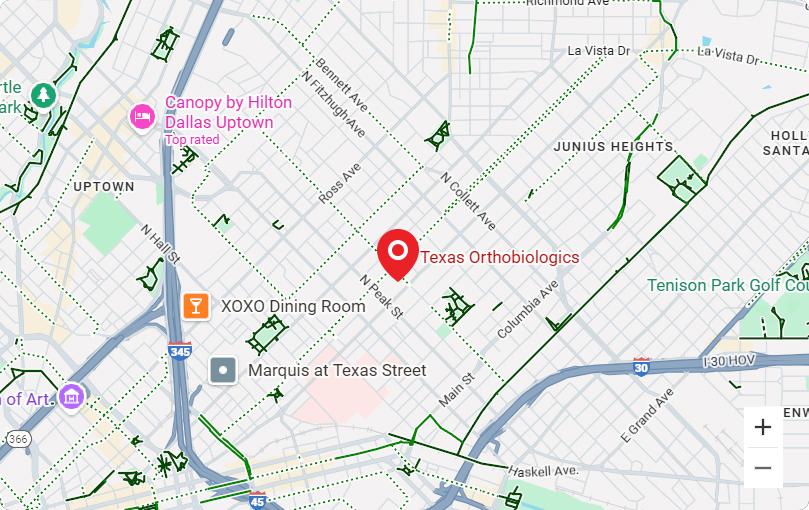
Texas Orthobiologics is at 3310 Live Oak, Suite 202, in Dallas. Call (877) 777-8883 or request a visit online. If you'd like to be seen before the holidays, reach out soon.
Areas We Serve
Our office is in Dallas, and patients come to us from across North Texas, including:
- Dallas and nearby: Highland Park & University Park, Irving, Richardson, Garland, Carrollton and Coppell
- Collin County: Plano, Frisco, McKinney, Allen and Prosper
- Northwest and Tarrant County: Grapevine, Southlake, Colleyville, Keller, Flower Mound and Fort Worth
Disclaimer: Individual results vary. This article is for educational purposes only and is not medical advice. PRP and BMAC (stem cells) are not FDA-approved treatments for arthritis or back pain. Please talk with a qualified physician about your specific condition.
References
- Belk JW, Kraeutler MJ, Houck DA, Goodrich JA, Dragoo JL, McCarty EC. Platelet-rich plasma versus hyaluronic acid for knee osteoarthritis: a systematic review and meta-analysis of randomized controlled trials. Am J Sports Med. 2021;49(1):249-260. doi:10.1177/0363546520909397. Abstract
- Bansal H, Leon J, Pont JL, et al. Platelet-rich plasma (PRP) in osteoarthritis (OA) knee: correct dose critical for long term clinical efficacy. Sci Rep. 2021;11(1):3971. doi:10.1038/s41598-021-83025-2. Abstract | Free full text
- Sambe HG, Yasir M, Man RK, et al. Comparing intra-articular platelet-rich plasma with hyaluronic acid for the treatment of hip osteoarthritis: a systematic review and meta-analysis. Cureus. 2023;15(10):e47919. doi:10.7759/cureus.47919. Abstract | Free full text
- Kim SJ, Kim EK, Kim SJ, Song DH. Effects of bone marrow aspirate concentrate and platelet-rich plasma on patients with partial tear of the rotator cuff tendon. J Orthop Surg Res. 2018;13(1):1. doi:10.1186/s13018-017-0693-x. Abstract | Free full text
- American Academy of Orthopaedic Surgeons. AAOS establishes Orthobiologics Registry to advance evidence-based orthobiologics research. Published December 5, 2025. Accessed November 5, 2026. https://www.aaos.org/aaos-home/newsroom/press-releases/aaos-establishes-orthobiologics-registry-to-advance-evidence-based-orthobiologics-research/
- Centeno CJ, Berger DR, Money BT, Dodson E, Urbanek CW, Steinmetz NJ. Percutaneous autologous bone marrow concentrate for knee osteoarthritis: patient-reported outcomes and progenitor cell content. Int Orthop. 2022;46(10):2219-2228. doi:10.1007/s00264-022-05524-9. Abstract | Free full text
- McAlindon TE, LaValley MP, Harvey WF, et al. Effect of intra-articular triamcinolone vs saline on knee cartilage volume and pain in patients with knee osteoarthritis: a randomized clinical trial. JAMA. 2017;317(19):1967-1975. doi:10.1001/jama.2017.5283. Abstract | Free full text
Don Buford, MD is a board certified orthopedic surgeon. That matters here because the same physician who can offer you an orthobiologic injection can also tell you honestly when an injection is not the right answer and an operation is. A clinic that cannot perform the surgery has no way to make that comparison.
Common questions
- Do these treatments use steroids or require surgery?
- No. Our PRP and BMAC (stem cells) treatments use your own blood or bone marrow, prepared in our office and placed with ultrasound guidance. They do not use steroids, and they are not surgery. Most visits take about an hour, and you go home the same day.
- How soon will I know if PRP or BMAC (stem cells) is working?
- Orthobiologics are not a quick fix. Your body's response builds over weeks, not days, and every patient is different. We'll explain what to expect for your condition and follow up with you after treatment.
- How do I know if I'm a good candidate?
- It depends on your diagnosis. We start with an exam, your imaging and an in-office ultrasound. If orthobiologics aren't a good fit, we'll tell you and walk you through other options, including physical therapy and surgery. We'll also go over your investment before you decide.