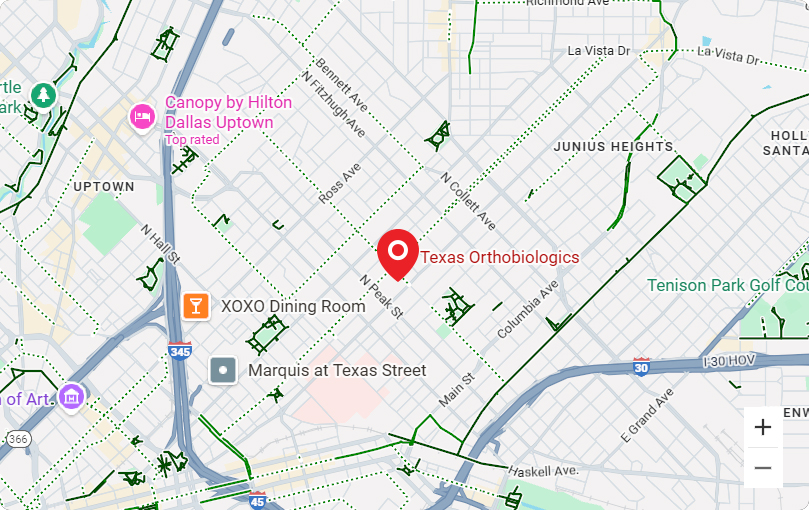
Knee surgery at Texas Orthobiologics is performed by Don Buford, M.D., a board-certified orthopedic surgeon, sports medicine fellowship-trained, with more than twenty-five years operating in Dallas. The knee procedures here are sports medicine procedures — the meniscus, the ligaments, the cartilage surface and the patellofemoral joint.
The same surgeon also performs the orthobiologic injections that are the alternative to several of them, which is why the consultation can genuinely go either way.
Knee procedures performed here
Meniscus repair and partial meniscectomy
The menisci are the two C-shaped shock absorbers between the femur and the tibia. They spread load across the joint surface, which is exactly why removing meniscal tissue has consequences later.
Repairing a meniscus is preferable to removing part of it whenever the tear is repairable — which depends on where the tear sits, its pattern, the blood supply to that zone and how long it has been there. When a tear genuinely is not repairable and is mechanically catching, a partial meniscectomy removes only the unstable fragment.
Worth being direct about one thing: a degenerative meniscal tear in an arthritic knee is a different problem from a traumatic tear in a healthy one, and arthroscopy has much less to offer the first. Where a scan shows the former, the conversation is usually about load, rehabilitation and sometimes a biologic rather than about surgery.
ACL reconstruction
The anterior cruciate ligament does not heal back to functional competence once it has torn through, and it cannot be repaired in the way a tendon can. It is reconstructed — a graft is passed through tunnels in the femur and tibia to replace it.
Not every ACL tear needs reconstructing. It depends on whether the knee is actually giving way, what sport or work you need it for, your age, and whether the meniscus and cartilage are intact. A knee that is stable in daily life in someone who does not pivot for a living is a different decision from a competitive cutting athlete's.
Cartilage restoration
A discrete full-thickness cartilage defect is its own problem and has its own set of operations. Three are performed here: MACI, osteochondral allograft transplantation and the CartiHeal Agili-C implant.
Cartilage restoration in Dallas, TX → — what each procedure is, the approvals and trial data behind them, how the choice between them is made, and the general rehabilitation milestones.
Patellofemoral surgery
The kneecap tracking badly, dislocating, or generating pain at the front of the knee is a distinct problem from the tibiofemoral joint. Procedures here address the soft tissue restraints, the alignment of the extensor mechanism, or the cartilage surface, depending on what is driving it.
This list is the sports medicine knee scope of this practice. It does not include knee replacement, which is not performed here.
How the decision to operate gets made
The knee is the joint where the gap between "something is torn on the scan" and "an operation will help" is widest. Almost everyone over forty has findings on a knee MRI. Most of them are not the reason the knee hurts.
What decides it:
- Whether the knee is mechanically failing. True locking, catching or giving way is a structural problem and behaves like one. Diffuse ache is usually something else.
- Traumatic or degenerative. A discrete injury in a sound knee and gradual wear across the whole surface are different problems with different answers.
- Whether the tissue is repairable — a repairable meniscus is worth repairing; an irreparable one is not worth pretending about.
- How much cartilage is left, and whether the defect is focal or diffuse.
- Alignment, and the rest of the joint. A knee that keeps failing because of how it is loaded needs that addressed too.
- Whether an orthobiologic is the better first move. For a painful knee with diffuse wear, often yes.
Recovery after knee surgery
Recovery varies more between knee procedures than between shoulder procedures, and the difference is not small. An arthroscopic partial meniscectomy is a relatively quick recovery. A meniscus repair has to be protected while it heals. An ACL reconstruction is a months-long rehabilitation programme. Cartilage restoration is longer again — the general milestones for those three procedures are set out on the cartilage restoration page.
The protocol depends on which procedure was done, what was found at surgery, and whether anything else was addressed at the same time. It is established individually and given to you before surgery rather than afterwards, so the commitment is clear while the decision is still being made.
Why it matters that both are on the table
Most practices in this market do one thing. An injection clinic cannot operate, so an injection is the only recommendation available to it. A surgical practice frequently does not offer well-prepared orthobiologics, so that conversation never really happens.
Dr. Buford does both. He performs the operations on this page, and he performs platelet-rich plasma and bone marrow concentrate injections himself, under ultrasound guidance, in the office. That means the question at the consultation can be the right one — what does the knee actually need — rather than a question shaped by what the practice is equipped to sell.
Sometimes the answer is an operation. Sometimes it is a biologic. Sometimes it is neither, and you will be told that too.
Request an appointment or call (877) 777-8883.
Common questions
Do you perform ACL reconstruction in Dallas?
Yes. ACL reconstruction is one of the knee procedures performed here by Don Buford, M.D., a board-certified orthopedic surgeon who is sports medicine fellowship-trained. Not every ACL tear needs reconstructing - it depends on whether the knee is actually giving way, what you need it for, your age, and whether the meniscus and cartilage are intact.
Does a meniscus tear need surgery?
Often not. A traumatic tear in an otherwise healthy knee that is mechanically catching or locking is a structural problem and behaves like one. A degenerative meniscal tear in an arthritic knee is a different problem, and arthroscopy has much less to offer it - there the conversation is usually about load, rehabilitation and sometimes an orthobiologic injection.
Is a meniscus repair better than removing part of the meniscus?
When the tear is repairable, yes. The menisci spread load across the joint surface, so removing meniscal tissue has consequences later. Whether a tear is repairable depends on where it sits, its pattern, the blood supply to that zone and how long it has been there. When a tear genuinely is not repairable and is catching mechanically, a partial meniscectomy removes only the unstable fragment.
What knee procedures do you perform?
Meniscus repair, arthroscopic partial meniscectomy, ACL reconstruction, cartilage restoration surgery - MACI, osteochondral allograft transplantation and the CartiHeal Agili-C implant - and patellofemoral procedures. These are sports medicine knee procedures. Knee replacement is not performed here.
I have knee arthritis. Do I need surgery?
Diffuse arthritis across the joint surface is not what these sports medicine procedures are for, and cartilage restoration specifically is indicated for a discrete defect in an otherwise sound joint rather than for widespread wear. For a painful knee with diffuse wear, an orthobiologic injection is one of the reasonable things to discuss, and it is available in this practice.
How long is recovery after knee surgery?
It varies more than most patients expect. An arthroscopic partial meniscectomy is a relatively quick recovery; a meniscus repair has to be protected while it heals; an ACL reconstruction is a months-long rehabilitation programme; cartilage restoration is longer again. The protocol depends on the procedure, what was found at surgery and whether anything else was addressed at the same time, and it is established individually and given to you before surgery.