PRP and Orthobiologics for Frisco, TX
Frisco has more competitive sport per square mile than anywhere else in North Texas. The injuries that follow are predictable: tendon overload in throwing shoulders and elbows, patellar and Achilles tendinopathy in year-round athletes, and the knee wear that shows up in the parents who coached them twenty years earlier.
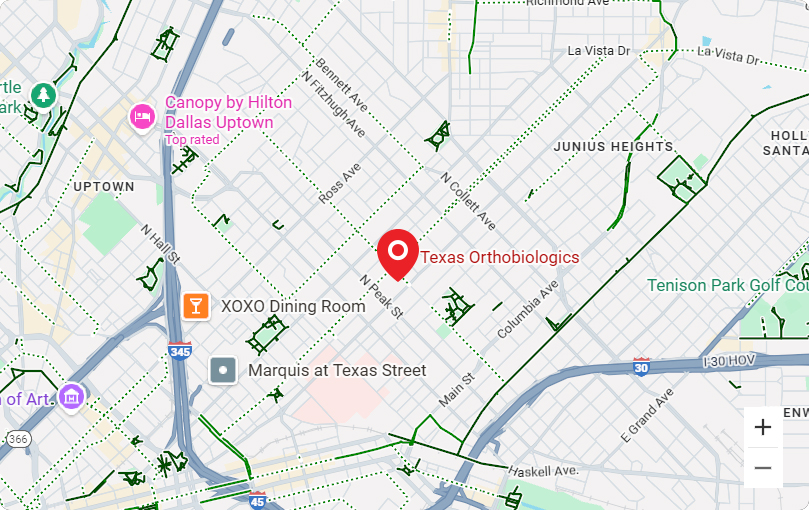
Texas Orthobiologics sees both groups. The practice is in Dallas, roughly thirty-five minutes from Frisco down the Dallas North Tollway.
Treated by the person who trains the trainers
Don Buford, MD is a board-certified orthopedic surgeon and, before medicine, played four seasons of professional baseball in the Baltimore Orioles organization. He understands what a throwing athlete is actually asking for, and what a lost season means.
Don Buford, MD is a board-certified orthopedic surgeon who has spent two decades teaching orthobiologics to other physicians. He serves as Chairman of the Biologic Association for 2026–2027, and is a past president of the Interventional Orthobiologics Foundation, where he served two terms and still sits on the Executive Committee and Board of Directors. He is in his fourth year on the Board of Directors of the Arthroscopy Association of North America and is founding editor of the Biologic Orthopedics Journal.
Since 2008 he has directed the Las Vegas Regenerative Medicine and MSK Ultrasound Course, one of the longest-running courses in the field, where more than 2,500 clinicians have trained.
Ultrasound guidance matters more in tendon work than almost anywhere else. The target is often millimetres across, and it is watched on screen as the needle enters it.
What is offered
- Platelet-rich plasma (PRP) — higher-dose protocols, because platelet dose is the variable most often responsible for a disappointing result.
- Bone marrow aspirate concentrate, BMAC (stem cells) — drawn from your own marrow and concentrated during the same visit.
- Cartilage restoration surgery — MACI, osteochondral allograft and CartiHeal Agili-C, for defects that an injection cannot address.
Every orthobiologic injection we perform is autologous, and every one is placed under ultrasound guidance so the needle is watched into the target in real time.
Both options. One board-certified surgeon.
Getting here from Frisco
The Dallas North Tollway south, then east through Uptown, reaches 3310 Live Oak Street in about thirty-five minutes outside peak hours. US-75 is the alternative and runs similarly. If you have prior images, our office can walk you through uploading them from our website at home, or point you to the imaging facility's own portal where you can often get them yourself. Mention it and we will help. For in-season athletes we will say plainly whether treatment is worth starting now or better timed to the off-season.
Common questions
Is my teenager too young for PRP?
Age alone does not decide it - the diagnosis does. Growing athletes often have growth-plate or apophyseal problems that respond to load management rather than injection, and treating those with an injection wastes time and money. The evaluation establishes which problem is present before anything is offered. Skeletally mature athletes with a confirmed tendon injury are assessed on the same basis as adults.
How much does PRP cost for a tendon injury?
High-dose single-injection PRP runs $1,500 to $3,500 nationally. Dose is the variable that matters most: the RESTORE trial delivered roughly 1.6 billion platelets per injection and found no benefit, while Bansal and colleagues, publishing in Scientific Reports in 2021, used ten billion platelets in eight millilitres and reported superiority over hyaluronic acid. Your investment is set out in writing before you decide.
Will I miss the season?
That depends on the tissue treated and where you are in the calendar, and it is discussed before anything is scheduled. Tendon treatment involves a deliberate period of protected loading afterwards, so starting mid-season is sometimes the wrong call even when the injection is right. We will tell you when waiting is the better option.
Request an appointment
New patient evaluations routinely run past forty-five minutes, because the imaging review is the appointment.
Other areas we serve
Texas Orthobiologics · 3310 Live Oak, Ste 202, Dallas, TX 75204 · (877) 777-8883. This page is for educational purposes only and does not constitute medical advice. Individual results vary.
Location
& Directions
Texas Orthobiologics
Don Buford, MD
3310 Live Oak
Ste 202
Dallas,
TX 75204
(877) 777-8883 (Dallas)
Monday - Friday: 8:30 am - 4:00 pm