Patients ask me whether PRP works. It is a reasonable question and it has no useful answer, because platelet-rich plasma is not a product. It is a category. Asking whether PRP works is like asking whether pills work.
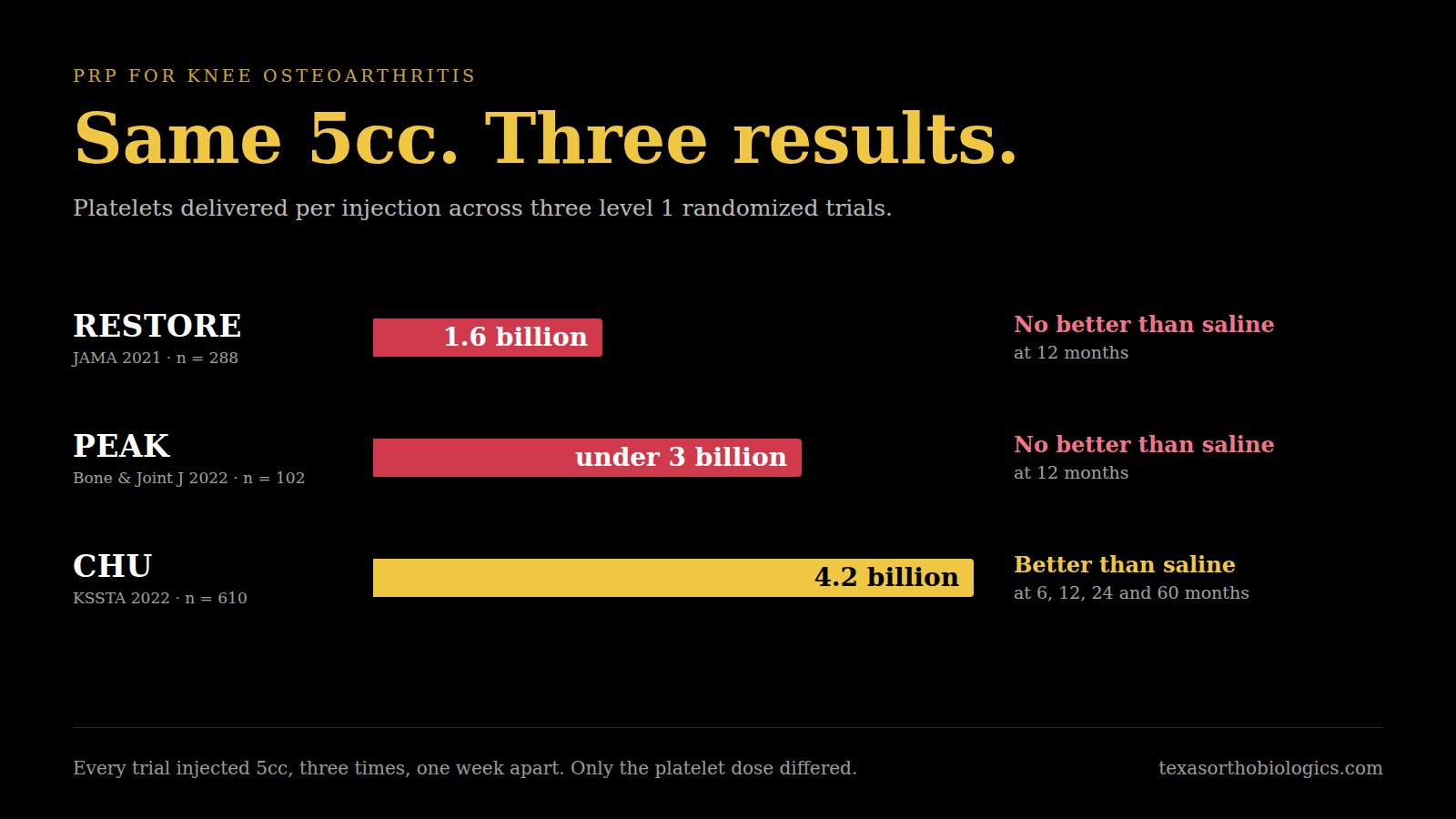
Here is what that looks like in practice. Three randomised trials injected the same 5cc volume into the same kind of arthritic knee on the same weekly schedule, three injections. Two found nothing at all. One is still showing benefit five years later, with half the cartilage loss. Every meaningful design feature was matched.
What differed was how much blood was drawn and how it was spun — and therefore how many platelets ended up in that 5cc syringe.
The same syringe, three different treatments
| Trial | Blood drawn | Platelets injected | Result |
|---|---|---|---|
| RESTORE JAMA, 2021 288 patients | 20cc single spin | 1.6 billion per injection 4.9 billion total | No better than saline at 12 months |
| PEAK Bone & Joint J, 2022 102 patients | 20cc Arthrex ACP | Under 3 billion per injection | No better than saline at 12 months |
| Chu KSSTA, 2022 610 patients | 50cc two-spin protocol | 4.2 billion per injection 12.6 billion total | Better than saline at 6, 12, 24 and 60 months |
All three drew the patient's own blood. All three injected 5cc. All three gave three injections a week apart. All three were randomised, blinded and saline-controlled — level 1 evidence, the strongest design available.
What RESTORE actually injected
RESTORE is the trial most often cited to argue that PRP does not work, and it published its own numbers openly — which is to its credit and is exactly why we can check them.
The participants' whole blood contained an average of 271 platelets per microlitre. The finished "platelet-rich" plasma contained 325.
That is a 1.2-fold concentration. A preparation twenty percent richer in platelets than the blood it came from, produced by a single five-minute spin. At 5cc, that is roughly 1.6 billion platelets per injection, and 4.9 billion across the entire three-injection course.
PEAK, using a different commercial system, delivered under 3 billion per injection and reached the same conclusion.
Neither trial did anything improper. Both used commercially available, FDA-cleared systems that thousands of clinics use every day. That is the finding. These are excellent trials demonstrating that low-dose PRP does not work — which is a different statement from "PRP does not work."
What happened when the dose cleared the floor
Chu and colleagues randomised 610 patients across nine hospitals — the largest and longest trial in this field — to three weekly injections of pure PRP or sham saline, and followed them for sixty months.
They drew 50cc rather than 20cc and used a two-spin protocol, producing 832 platelets per microlitre: 4.2 billion in the same 5cc syringe, 12.6 billion across the course.
The PRP group exceeded the minimum clinically important difference on WOMAC, IKDC and VAS at two years, and remained better than saline on pain, function and total WOMAC at five. Inflammatory markers in the joint fluid were lower at six months. And cartilage volume loss over five years was roughly halved — 1,171 cubic millimetres versus 2,311 in the saline group.
Where the floor is
That is the question our team set out to answer directly. I was one of ten authors on a systematic review and meta-analysis published in PM&R in 2026. We screened 4,638 records and pooled 32 randomised trials covering 3,589 patients, sorting them not by brand or kit but by how many platelets were actually delivered.
PRP outperformed both saline and hyaluronic acid. And our dosing recommendation was specific: deliver at least 5 to 10 billion total platelets.
Now put RESTORE next to that number. Its entire three-injection course delivered 4.9 billion platelets — less than the minimum we identified for a single course of treatment. Chu delivered 12.6 billion.
Read that way, the literature stops looking like a controversy about whether PRP works and starts looking like a dosing problem with a number attached.
One detail in Chu's protocol deserves attention, because it is the part most easily missed: that 12.6 billion was not given all at once. It was 4.2 billion at a time, once a week for three weeks. How much, and how it is spread out, are two different questions — and the second one has had far less attention than it deserves.
A second review, a different measure, the same direction
Ours is not the only group to have looked at this. A 2025 meta-analysis in the American Journal of Sports Medicine pooled 18 randomised placebo-controlled trials covering 1,995 patients and split them by platelet concentration rather than total dose, using a cutoff around one million platelets per microlitre.
High-platelet PRP produced pain relief that exceeded the minimum clinically important difference at three, six and twelve months. Low-platelet PRP did not reach a clinically perceivable benefit on pain at any point. On function, both groups improved — but only the high-platelet group still had a significant advantage at twelve months.
Two independent teams, two different ways of measuring the same variable, the same conclusion: under-dosed PRP behaves like placebo, and adequately dosed PRP does not.
Who this is for
PRP is a first-choice orthobiologic for patients with symptomatic Kellgren-Lawrence grade 2 or 3 knee osteoarthritis who have failed other treatment modalities, or who are interested in the orthobiologic approach.
That is worth reading twice next to the table above, because Kellgren-Lawrence 2 and 3 is exactly the population RESTORE enrolled. The disagreement in this literature is not about which patients PRP is for. It is about how much platelet they were given.
What this means if you are considering PRP
You are entitled to ask four questions before anyone puts a needle in your knee, and you should expect real answers:
- What platelet dose am I getting? Not the kit's marketing claim, and not a concentration multiple — the number of platelets in the syringe, for your blood, on your day.
- How do you know? A clinic that does not count cannot answer.
- How much blood are you drawing? You cannot deliver platelets you never collected. A 60cc draw from someone with an ordinary platelet count of 200,000 per microlitre starts with roughly 12 billion platelets to work with. A 20cc draw starts with about 4 billion — before a single one is lost in processing.
- What is your system's platelet recovery rate, and is it consistent? A kit that reliably recovers 70 percent of what you collected turns that 60cc draw into roughly 8 billion platelets in the syringe. A kit that recovers a third of them does not.
Those two numbers — blood drawn and platelets recovered — are the entire game. If you want a higher dose, there are only two levers: draw more blood, or use a better kit.
If a clinic cannot tell you what it gave you, it also cannot tell you why the injection did or did not work. Neither can you.
What we do
I draw 120cc to prepare PRP for a typical knee, hip or shoulder injection — 108cc of blood plus 12cc of anticoagulant. At an average platelet count that is 21.6 billion platelets to start with. RESTORE and PEAK drew 20cc; following their kits' published protocols, that is roughly four billion to start with, and RESTORE delivered 1.6 billion of them.
From there we use a two-spin protocol that removes red blood cells and neutrophils while concentrating the monocytes and lymphocytes. Start to finish, preparing the PRP takes nine and a half minutes.
Our platelet recovery rate is 70 percent, so a single injection delivers 15.1 billion platelets. That is roughly three times what RESTORE delivered across its entire three-injection course, and more in one visit than the five-year Chu protocol delivered across three.
The final volume and concentration vary with the joint being injected. The platelet dose does not. That is the entire argument of this post in one sentence: the unit that matters is platelets delivered, not millilitres in a syringe — and 21.6 billion in the tube is not 21.6 billion in your knee, which is why the number worth quoting is the one measured at the end.
We do this because the alternative is administering a treatment without knowing what was in it, and then drawing conclusions from the result. That is not a standard I would accept as a patient.
The honest limits
A systematic review is only as good as the trials inside it. Ours varied in quality and follow-up, and for many of them the delivered dose had to be reconstructed rather than read off the page. The trials also disagreed with one another substantially, and our own statistical tests suggested that small negative studies are under-represented in the published literature.
What the evidence establishes is a floor, not a formula. Below it, careful trials keep coming back negative. Above it, the results improve. It does not follow that more is proportionally better without limit, and I would be overselling this if I told you it did.
Dose is also not the only thing that matters. Leukocyte content, activation, injection accuracy, the joint's starting condition and what the patient does afterwards all contribute. Dose is simply the variable that is easiest to measure, most often ignored, and the one that best explains why the trial literature argues with itself.
PRP is also not right for every knee. In grade 3 and 4 arthritis, where the joint space is largely gone and much of the pain is coming from the bone rather than the cartilage, injecting anything into the joint alone is treating the wrong compartment. Those patients often have better options — including bone marrow concentrate delivered into the bone above and below the joint as well as into the joint itself, and in some cases surgery. That is a different conversation, and one we have honestly rather than selling a PRP injection that was never going to be enough.
Common questions
- How much PRP do I actually need for knee arthritis?
- Our systematic review of 32 randomised trials and 3,589 patients recommends delivering at least 5 to 10 billion total platelets. For scale: RESTORE, the large JAMA trial that found no benefit, delivered about 1.6 billion per injection and 4.9 billion across its whole three-injection course. Chu's 610-patient trial, which showed benefit out to five years, delivered 4.2 billion per injection and 12.6 billion across the course.
- I read in JAMA that PRP doesn't work. Was that wrong?
- It was right about what it tested. RESTORE's preparation was 1.2 times as concentrated as the patients' own blood — a twenty percent increase — and it performed like saline. Chu's trial, using a 50cc draw and a two-spin protocol to deliver roughly two and a half times as many platelets in the same 5cc syringe, found benefit sustained to five years and half the cartilage loss. The two results are not in conflict once you know the dose.
- What dose does Dr. Buford deliver?
- We draw 120cc — 108cc of blood plus anticoagulant — which at an average platelet count starts with 21.6 billion platelets. A two-spin protocol removes red cells and neutrophils while retaining monocytes and lymphocytes, and our platelet recovery rate is 70 percent. A single injection delivers 15.1 billion platelets. The volume and concentration vary with the joint; the platelet dose does not.
More questions
Am I a candidate for PRP?
PRP is a first-choice orthobiologic for symptomatic Kellgren-Lawrence grade 2 or 3 knee osteoarthritis in patients who have failed other treatments, or who want to start with an orthobiologic approach. For grade 3 and 4 arthritis we usually recommend something other than PRP alone — most often bone marrow concentrate delivered into the bone as well as the joint, since in advanced arthritis much of the pain originates in the bone.
My doctor said the PRP kit is FDA-cleared. Doesn't that mean it works?
Clearance concerns the device's safety and its ability to do what it claims mechanically. It is not a finding that the resulting preparation improves your knee, and it says nothing about the dose delivered to you. RESTORE and PEAK both used FDA-cleared, commercially available systems.
How much blood should be drawn for a PRP injection?
Enough that the target dose is achievable before processing losses. At an ordinary platelet count of about 200,000 per microlitre, a 60cc draw starts with roughly 12 billion platelets; with a system recovering 70 percent, that is about 8 billion in the syringe. A 20cc draw — what RESTORE and PEAK used — starts with roughly 4 billion, which caps the deliverable dose before anything else happens.
Is more platelets always better?
What the evidence establishes is a floor, not a ceiling. Below it, careful trials keep coming back negative. Above it, outcomes improve. I would not tell you that doubling again doubles the benefit — that has not been shown.
How many injections should I have?
The best long-term evidence — Chu's five-year trial — used three injections a week apart. It is worth noting that the total dose there was built up across a course rather than delivered in one large injection, and that "how much" and "how often" are separate questions the literature has only begun to separate.
I had PRP elsewhere and it didn't help. Was the dose the problem?
Possibly, and there is often no way to know, because most clinics do not measure. If you bring records showing what was prepared — the blood volume drawn, the system used, the injected volume — we can sometimes reconstruct it.
Does this apply to PRP outside the knee?
Our review examined knee osteoarthritis specifically, so that is what it establishes. The dose principle appears in tendon and spine literature as well, but I would not claim this paper as evidence for those sites.
References
Hooper N, Shapiro S, Paidsetty V, Azarpey A, Jindal A, Mautner K, Easley K, Buford D, Sussman W, Jayaram P. Platelet-rich plasma outcomes in knee osteoarthritis are associated with the amount of total deliverable platelets: a systematic review and meta-analysis. PM&R. 2026. PubMed · doi:10.1002/pmrj.13455
Chu J, Duan W, Yu Z, Tao T, Xu J, Ma Q, Zhao L, Guo JJ. Intra-articular injections of platelet-rich plasma decrease pain and improve functional outcomes than sham saline in patients with knee osteoarthritis. Knee Surg Sports Traumatol Arthrosc. 2022;30(12):4063–4071. PubMed
Bensa A, Previtali D, Sangiorgio A, Boffa A, Salerno M, Filardo G. PRP injections for the treatment of knee osteoarthritis: the improvement is clinically significant and influenced by platelet concentration: a meta-analysis of randomized controlled trials. Am J Sports Med. 2025;53(3):745–754. PubMed
Bennell KL, Paterson KL, Metcalf BR, et al. Effect of intra-articular platelet-rich plasma vs placebo injection on pain and medial tibial cartilage volume in patients with knee osteoarthritis: the RESTORE randomized clinical trial. JAMA. 2021;326(20):2021–2030. PubMed
Lewis E, Merghani K, Robertson I, et al. The effectiveness of leucocyte-poor platelet-rich plasma injections on symptomatic early osteoarthritis of the knee: the PEAK randomized controlled trial. Bone Joint J. 2022;104-B(6):663–671. PubMed
Further reading: orthobiologics for the knee · published research
Because Don Buford, MD performs both orthopedic surgery and orthobiologic procedures, the recommendation you get is not limited by what the office is equipped to offer. Some patients are better served by an injection. Some are better served by an operation. Both conversations can happen in the same visit.