PRP and Orthobiologics for Allen, TX
Allen sends us two kinds of patient: athletes with tendon injuries that have not settled with rest, and adults in their forties and fifties whose knees have started to limit what they can do on a weekend. The treatments overlap. The reasoning behind them does not, and that is what the evaluation is for.
The office is at 3310 Live Oak Street in Dallas, about thirty-five minutes south on US-75.
Ultrasound guidance, and why it is the thing to ask about
Every orthobiologic injection here is placed under ultrasound guidance. The needle is watched on screen into the target tissue rather than positioned by landmark and feel. For small tendon targets that difference decides whether the injection reached what it was aimed at. It is a fair question to ask any provider, and worth asking.
Don Buford, MD is a board-certified orthopedic surgeon who has spent two decades teaching orthobiologics to other physicians. He serves as Chairman of the Biologic Association for 2026–2027, and is a past president of the Interventional Orthobiologics Foundation, where he served two terms and still sits on the Executive Committee and Board of Directors. He is in his fourth year on the Board of Directors of the Arthroscopy Association of North America and is founding editor of the Biologic Orthopedics Journal.
Since 2008 he has directed the Las Vegas Regenerative Medicine and MSK Ultrasound Course, one of the longest-running courses in the field, where more than 2,500 clinicians have trained.
Products without a clear regulatory pathway and published human outcomes - amniotic fluid, Wharton's jelly and exosome preparations - are not used here. That standard is applied consistently in both directions, and it is also the reason MACI, osteochondral allograft and CartiHeal Agili-C are offered.
What is offered
- Platelet-rich plasma (PRP) — higher-dose protocols, because platelet dose is the variable most often responsible for a disappointing result.
- Bone marrow aspirate concentrate, BMAC (stem cells) — drawn from your own marrow and concentrated during the same visit.
- Cartilage restoration surgery — MACI, osteochondral allograft and CartiHeal Agili-C, for defects that an injection cannot address.
Every orthobiologic injection we perform is autologous, and every one is placed under ultrasound guidance so the needle is watched into the target in real time.
Both options. One board-certified surgeon.
Getting here from Allen
US-75 south to Haskell Avenue, roughly thirty-five minutes clear of rush hour. Parking is on site. If you have a prior MRI, X-ray or ultrasound, our office can show you how to upload it from our website at home, or you may be able to log in to the facility that performed it and get it directly. Mention it and we will help.
Common questions
Why does ultrasound guidance matter for an injection?
It confirms the treatment reached the tissue you are paying to treat. Tendon and joint targets are frequently only a few millimetres across, and an injection placed by feel can miss. Every orthobiologic injection in this practice is placed under ultrasound guidance, watched in real time. Dr. Buford has taught that technique to more than 2,500 clinicians since 2008.
How much does PRP cost, and is it covered by insurance?
Orthobiologic injections are generally not covered by insurance. High-dose PRP runs $1,500 to $3,500 nationally and BMAC $5,000 to $13,000, depending on how many joints are treated. Those are national ranges rather than a quote for your treatment; your own investment is confirmed in writing before you decide. CareCredit offers interest-free terms of six to eighteen months.
Can PRP regrow the cartilage in my knee?
No. No injection has been shown to regrow a joint surface, and any clinic promising that is overstating the evidence. What orthobiologic injections can do is reduce pain and improve function in appropriately selected patients. Where a cartilage defect genuinely needs structural repair, that is a surgical question, and MACI, osteochondral allograft and CartiHeal Agili-C are the procedures offered here.
Request an appointment
New patient evaluations routinely run past forty-five minutes, because the imaging review is the appointment.
Other areas we serve
Texas Orthobiologics · 3310 Live Oak, Ste 202, Dallas, TX 75204 · (877) 777-8883. This page is for educational purposes only and does not constitute medical advice. Individual results vary.
Location
& Directions
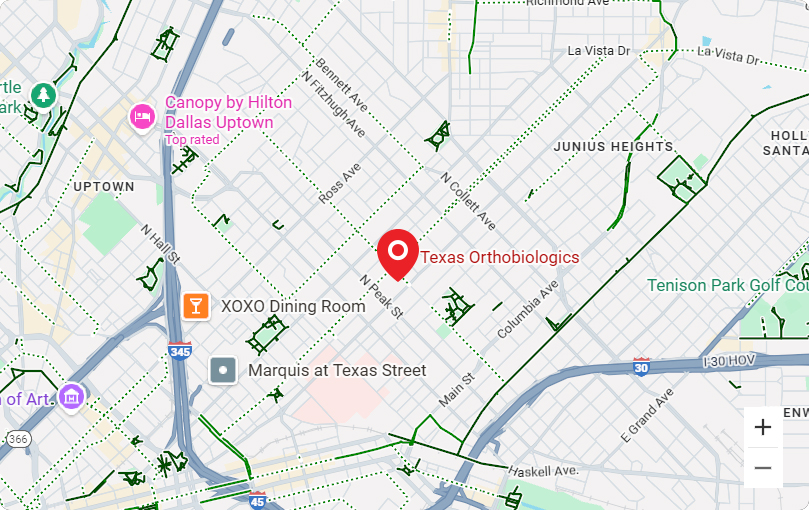
Texas Orthobiologics
Don Buford, MD
3310 Live Oak
Ste 202
Dallas,
TX 75204
(877) 777-8883 (Dallas)
Monday - Friday: 8:30 am - 4:00 pm