If you live in the Dallas–Fort Worth area and you have searched for a stem cell injection for your knee, hip, shoulder or back, you have almost certainly been offered an amniotic or umbilical cord product. It is sold under a lot of names: amniotic fluid, amniotic membrane, umbilical cord blood, Wharton's jelly, placental tissue, birth tissue allograft, and more recently regenerative protein array. The pitch is nearly always the same, and it is nearly always some version of these are young, powerful stem cells from a donated birth tissue.
Here is the direct answer, and it has not changed in nine years of writing about this.
Pay attention to the newer names. Terms like regenerative protein array have appeared as the FDA has tightened its position on these products, and they share one feature: they avoid the words stem cell. If a clinic has stopped calling it a stem cell injection but is still selling you the same donated birth tissue out of the same vial, the product has not changed. Only the label has, and the regulations follow the product rather than the marketing.
There are no living stem cells in these products
This is not a matter of opinion or of one doctor's preference. In 2019 more than twenty physicians, PhDs and researchers from major United States universities and practices signed a consensus statement on birth tissue products, and their finding was that these products do not contain living, functional stem cells by the time they reach a treatment room. They are frozen, shipped, and thawed in an office in a few minutes. Whatever was alive in the donated tissue is not alive when it goes into your joint.
Independent laboratory work published since has repeatedly confirmed the same thing for allograft products marketed as containing living cells.
So the first problem with an amniotic stem cell injection is the plainest one. Whatever you are paying for, it is not a stem cell injection.
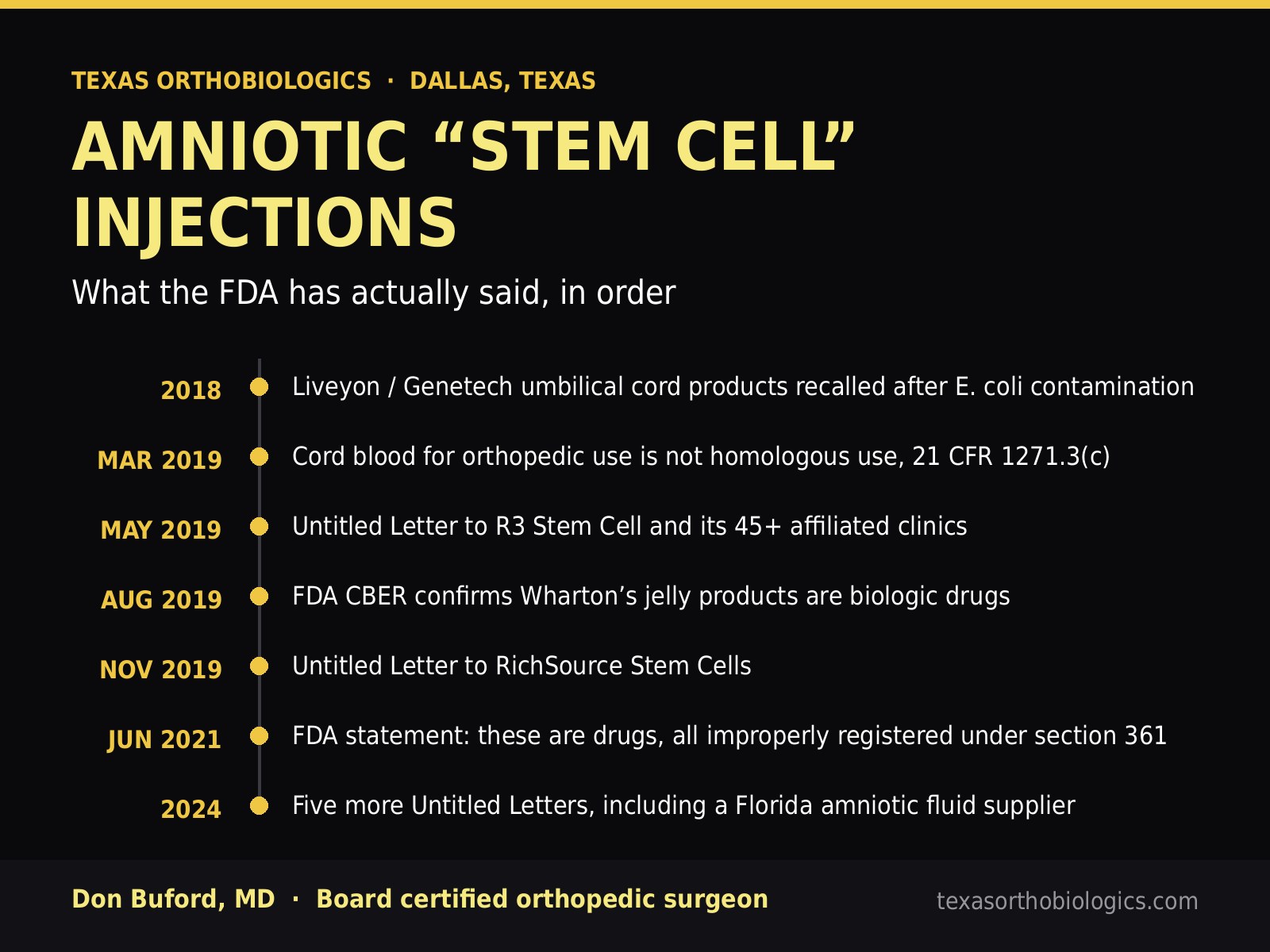
What the FDA has actually said, in order
The regulatory history here is long, public, and remarkably consistent. A short version:
- Registration is not approval. A company can register a birth tissue product with the FDA under section 361 in about forty five minutes. That registration means the company filled in a form. It does not mean the FDA reviewed the product, tested it, or agreed with a single claim made about it. Clinics routinely show patients an FDA registration number as though it were an approval. It is not.
- 2018. Liveyon recalled umbilical cord blood products made by Genetech in San Diego after contamination with E. coli. Patients were hospitalized. This is what happens when tissue from another person is processed outside the controls that apply to an actual drug.
- March 2019. The FDA stated that using umbilical cord blood products to treat orthopedic conditions is not homologous use as defined in 21 CFR 1271.3(c). In plain language: cord blood exists to make blood. Injecting it into a knee is not what it does in the body it came from, so it does not qualify for the simple registration pathway.
- May 2019. The FDA sent an Untitled Letter to R3 Stem Cell, an organization with more than forty five affiliated clinics selling birth tissue products for conditions including ALS and diabetes.
- August 2019. A physician wrote to the FDA's CBER division and asked directly whether Wharton's jelly products were being correctly regulated. The FDA said no. Every Wharton's jelly allograft product then on the market was being sold outside the regulations.
- November 2019. An Untitled Letter to RichSource Stem Cells, laying out the false claims being made both to clinicians buying these products and to the patients receiving them.
- June 2021. The FDA issued a statement making the position explicit: umbilical cord blood, amniotic fluid, Wharton's jelly, exosomes and stromal vascular fraction are all biologic drugs, and all are improperly registered under section 361 when used for orthopedic problems. Worth noting what was not on that list: platelet rich plasma and bone marrow concentrate. The FDA could have included them. It did not.
- 2024. Five more Untitled Letters, including one to a Wharton's jelly and umbilical cord company, one to an exosome company, and one to a Florida amniotic membrane and fluid supplier. Each was told the same thing: these products are drugs, and they cannot be sold or used in humans in the United States without FDA approval.
The FDA maintains a public page of these letters. Nearly every company that has been selling amniotic fluid, umbilical cord blood, Wharton's jelly, exosomes or stromal vascular fraction for orthopedic use is on it.
As of 2026, none of this has changed. There is no new ruling, no quiet reversal, no exception that has opened up. A handful of specific products hold approval to be studied in formal clinical trials, which is a different thing from being available for sale in a clinic.
What the research shows compared with PRP
Set the regulations aside for a moment and ask the question a patient actually cares about: does it work?
Platelet rich plasma for knee arthritis has been studied in more than thirty level 1 randomized trials. A pooled analysis of twenty four studies covering 2,315 patients found benefit at six months that was still present at twelve. That is a real, replicated, published evidence base, and it is why we use PRP.
For birth tissue products used in orthopedics, there is almost nothing comparable. The closest well designed trial to date is a 2024 study from a research group in Iran that compared 5cc of placental derived exosomes against 5cc of ordinary saline in twenty nine patients, fifty eight knees, with MRI scans before and after and six months of follow up. There was no measurable difference between the treated knee and the saline knee.
That is the state of the evidence. One side has thirty years of trials and a couple of thousand patients. The other has a small number of studies, and the best controlled one could not beat salt water.
Questions worth asking any clinic offering this
- Where do the cells come from? If the answer is anything other than your own body, there are no living stem cells in it.
- What is the product actually called on the vial, and who makes it? Marketing names change faster than products do. A regenerative protein array and an amniotic stem cell injection can be the same material with two different labels.
- Is this product FDA approved, or FDA registered? Ask for the distinction in writing.
- Can you show me published human outcome data for this product in this joint?
- Who is performing the injection, and what is their training? Many of these products are injected by clinicians who are not orthopedic physicians and who cannot manage the problem if the injection is not the right answer.
- If a study is mentioned, is it an FDA authorized trial? A clinic running its own study, or one merely listed on a registry, does not make an unapproved drug legal.
What we do at Texas Orthobiologics instead
We use platelet rich plasma and bone marrow concentrate, both taken from your own body on the day of the procedure, both placed under ultrasound guidance, and both measured in our office so the dose is a known number rather than an assumption. Those two are also the two the FDA pointedly left off its 2021 list.
Not everyone is a candidate, and results vary from patient to patient. But you will be told what is in the syringe, what the published evidence supports, and when an injection is not the right answer at all.
Because Don Buford, MD performs both orthopedic surgery and orthobiologic procedures, the recommendation you get is not limited by what the office is equipped to offer. Some patients are better served by an injection. Some are better served by an operation. Both conversations can happen in the same visit.
Common questions
- Are amniotic stem cell injections legal in the USA?
- Not for orthopedic use. In June 2021 the FDA stated that amniotic fluid, umbilical cord blood, Wharton's jelly, exosomes and stromal vascular fraction are biologic drugs and are improperly registered under section 361 for orthopedic applications. Selling or injecting them without FDA approval falls outside the regulations. A small number of specific products hold approval to be studied in formal clinical trials, which is not the same as being available in a clinic.
- Do amniotic or umbilical cord products contain living stem cells?
- No. In 2019 more than twenty physicians, PhDs and researchers from major United States universities signed a consensus statement finding that these products do not contain living, functional stem cells. They are frozen, shipped, and thawed in an office in minutes, and independent laboratory work has repeatedly confirmed the same result.
- What is a regenerative protein array?
- It is one of several newer marketing names for the same donated birth tissue products described here. The term points at proteins and growth factors said to be in the material rather than at cells, which sidesteps the stem cell claim that independent researchers and the FDA have both contradicted. The regulatory position does not change with the name. If the product comes from amniotic fluid, umbilical cord, Wharton's jelly or placental tissue and is being used for an orthopedic problem, the FDA treats it as an unapproved biologic drug regardless of what it is called.