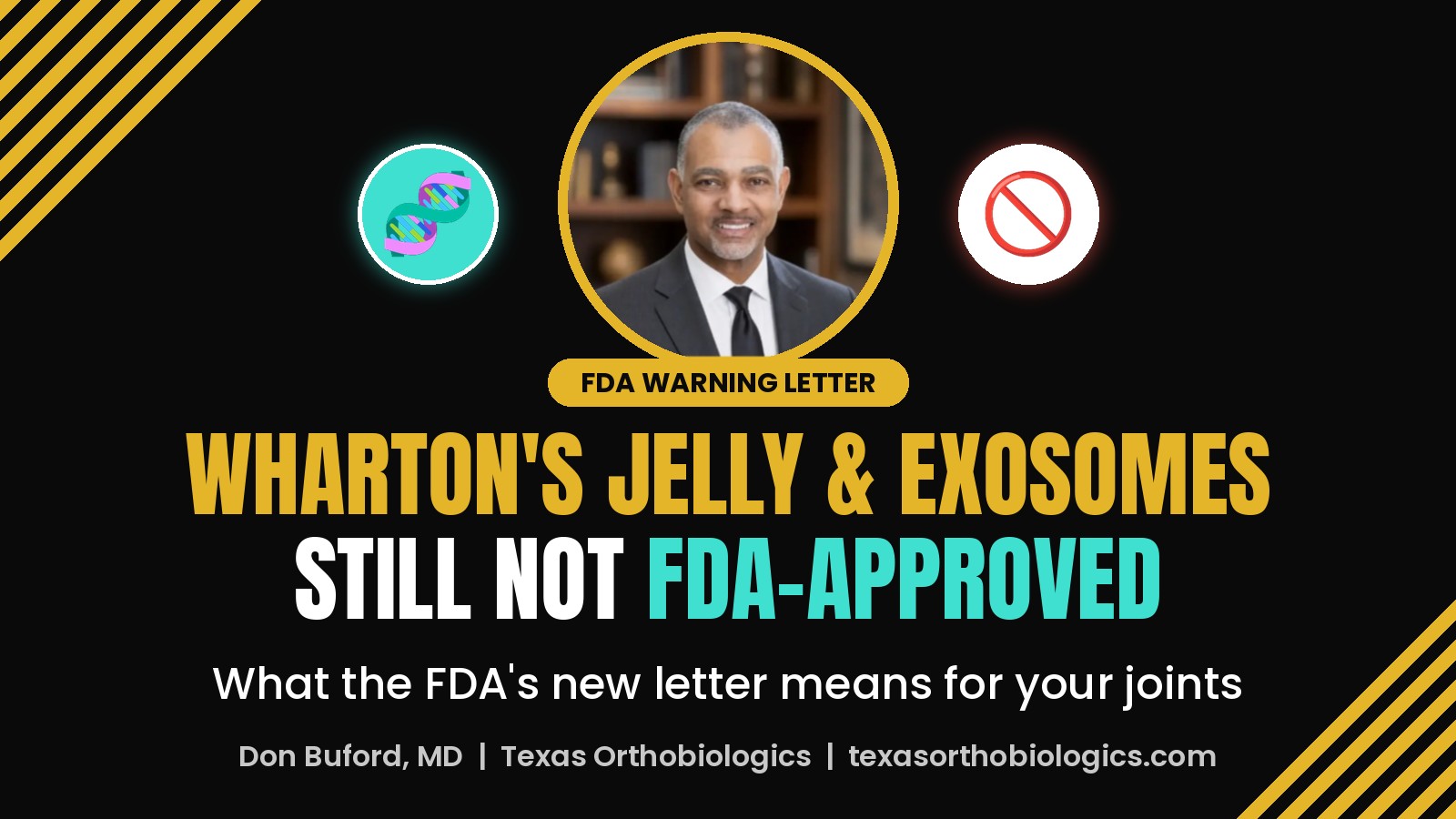
If you've seen ads for "stem cell" shots made from umbilical cord, Wharton's jelly or exosomes, a new letter from the U.S. Food and Drug Administration (FDA) is worth reading. On October 13, 2026, the FDA sent a warning letter to an IV hydration clinic that sold umbilical cord products and exosome products as IV treatments.1 The FDA said these products are unapproved drugs and unlicensed biologics.
The letter is short, but its wording matters for anyone thinking about these products for a sore knee, hip, shoulder or tendon. As an orthopedic surgeon who works in regenerative medicine every day, here's what it says, what it means and what to ask before you pay for any "regenerative" shot.
The Bottom Line
- Umbilical cord products, including Wharton's jelly: not FDA-approved for any orthopedic condition, such as arthritis or joint pain.2
- Exosomes: the FDA says "there are currently no FDA-approved exosome products."2,3
- The only legal way to use them for these conditions in the U.S.: inside an FDA-cleared research study, called an Investigational New Drug (IND) study.4
What Are Wharton's Jelly and Exosomes?
The umbilical cord is the lifeline between a mother and her baby. Wharton's jelly is the soft, jelly-like tissue inside the cord that cushions and protects its blood vessels. After a healthy birth, some companies collect donated cords and process them into products that are injected or given by IV.
Exosomes are tiny packages that cells release to "talk" to other cells. They are much smaller than cells. Some companies collect them from cells grown in a lab and sell them as treatments.
Both are donor products, which means they come from someone else, not your own body.
What the FDA Letter Says
The FDA reviewed the clinic's website, which offered "Stem Cell IV," "Exosome IV" and combination packages. The website said these products could help with things like joint pain, arthritis pain, inflammation, damaged tissue and hip pain.1
Based on those uses, the FDA said the products are "drugs" under federal drug law and "biological products" under the Public Health Service Act. Drugs and biologics need FDA approval or a license before they can be sold. These products had neither.1
The "361" Rule, in Plain English
Federal rules let some human tissue products be used without going through the full drug approval process. These products are often called "361 products," after the section of the law that covers them. To qualify, a product has to meet all four criteria in the FDA's rules, 21 CFR 1271.10(a).5 In simple terms:
- Minimally manipulated: it hasn't been processed in a way that changes its basic nature.
- Homologous use only: it does the same basic job in the patient that it did in the donor.
- Not combined with another article: apart from a few allowed things like water or a preservative.
- No systemic effect, or limited use: it doesn't work throughout the body or depend on living cells, unless it is used in the same person, a close blood relative or for reproduction.
Miss even one, and the product is regulated as a drug and biologic. In this letter, the FDA said the umbilical cord product "fails to meet all criteria in 21 CFR 1271.10(a)" and that "this HCT/P is not regulated solely under section 361 of the PHS Act."1 (HCT/P is the FDA's term for human cells, tissues and cell or tissue-based products.)
Homologous Use: The Key Phrase
"Homologous use" means a tissue does the same basic job in the patient as it did in the donor.6 A skin graft used to cover a burn is a simple example. Skin covers and protects, and that's its job in both people.
Here is how the FDA explained it in this letter: the product is not used to do the same basic job "of the HCT/P in the recipient as in the donor (e.g., serving as a conduit for umbilical cord)." Instead, the FDA said, the product was being used for "joint pain, arthritis pain, inflammation, damaged tissue, and hip pain, which is not a basic function of umbilical cord in the donor."1
Think about what that means. In its natural job, an umbilical cord carries blood between mother and baby. It doesn't repair cartilage, heal a tendon or calm an arthritic hip. In my reading, the FDA's reasoning leaves little room for using umbilical cord tissue, including Wharton's jelly, to treat joints, tendons or other orthopedic problems outside of an approved study. The FDA has said the same thing more broadly in its consumer alert: none of these products has been approved "for the treatment of any orthopedic condition, such as osteoarthritis."2
It's Not Just About Bold Ads
Some people think the problem is only flashy marketing, and that a clinic can stay legal by toning down its website. The rules don't work that way. Under the FDA's rule, homologous use is judged by "the labeling, advertising, or other indications of the manufacturer's objective intent."5 In other words, the FDA looks at what a product is actually being sold and used for. If an umbilical cord product is offered for a knee, that use is the issue, however mildly it's described.
What About Exosomes?
The letter treated the exosome products as unapproved drugs and biologics, too. In a footnote, it pointed to the FDA's public safety notice on exosome products, which was issued "following multiple reports of serious adverse events experienced by patients who were treated with exosome products."1,3
The FDA's position on exosomes has been clear for years: exosomes used to treat disease are regulated as drugs and biologics, and "there are currently no FDA-approved exosome products."3
Questions to Ask Before Any "Regenerative" Shot
- Is this product FDA-approved for my condition? If the answer is no, ask the next question.
- Is this part of an FDA-cleared study? If so, ask for the IND number and the consent form.3
- Where does it come from? Your own body, or a donor or a lab?
- What exactly is in it, and how much? A good clinic can tell you what you're getting.
- What are the risks? Ask about infection and reactions, and what happens if something goes wrong.
Also be careful with the phrase "FDA registered." A company that registers its facility with the FDA has not had its product approved by the FDA. Those are two different things.
How We Approach Regenerative Care
At Texas Orthobiologics, our orthobiologic options come from your own body. We have never used donor products for injection, including umbilical cord, Wharton's jelly, placental or exosome products. Platelet-rich plasma (PRP) comes from your own blood, and BMAC (stem cells) comes from your own bone marrow. Both are prepared in our office and given in the same visit, which takes about an hour. We avoid steroids.
Our rule is simple: to be a treatment option here, a product has to be supported by evidence and it has to be regulatory compliant. Both, not one or the other. I have held this stance since 2006 to keep my patients safe and to stay regulatory compliant.
This isn't about one clinic. If a clinic is willing to cut corners or operate in a "gray zone," what other corners are they willing to cut? Why?
In my experience, most clinics selling these products never get a warning letter from the FDA. Real penalties, like fines or action against a medical license, are rare, so many clinics simply hope not to get caught. If they are caught, they often take down a web page or just give the product a new name.
No treatment is right for everyone. We'll look at what's causing your pain and walk you through your options, including surgery when it makes sense, so you can make an informed choice.
Who's Treating You
I'm an orthopedic surgeon, board-certified by the American Board of Orthopaedic Surgery. I serve as Chairman of the Biologic Association for 2026 to 2027, I'm a two-term past President of the Interventional Orthobiologics Foundation (IOF), and I'm the Founding Editor of the Biologic Orthopedics Journal. Since 2008, I've directed the Las Vegas Regenerative Medicine and MSK Ultrasound Course, which has trained more than 2,500 clinicians. As a surgeon, I can walk you through every option, including surgery, before you decide.
Explore Your Options
If you're weighing a regenerative treatment for joint, tendon or back pain, come talk with us. We'll explain what the science says, what's legal, your options and your investment, with no pressure.
Texas Orthobiologics is at 3310 Live Oak, Suite 202, in Dallas. Call (877) 777-8883 or request a visit online.
Areas We Serve
Our office is in Dallas, and patients come to us from across North Texas, including:
- Dallas and nearby: Highland Park & University Park, Irving, Richardson, Garland, Carrollton and Coppell
- Collin County: Plano, Frisco, McKinney, Allen and Prosper
- Northwest and Tarrant County: Grapevine, Southlake, Colleyville, Keller, Flower Mound and Fort Worth
Disclaimer: This article is for educational purposes only and is not medical or legal advice. It describes a public FDA warning letter and FDA guidance as of November 2026; a warning letter reflects the FDA's position and is not a final court ruling. PRP and BMAC (stem cells) are not FDA-approved treatments for arthritis or other orthopedic conditions. Individual results vary. Please talk with a qualified physician about your specific condition.
References
- US Food and Drug Administration, Center for Biologics Evaluation and Research. Warning letter to Calibrate IV Hydration, CBER-26-729846. October 13, 2026. Accessed November 9, 2026. https://www.fda.gov/inspections-compliance-enforcement-and-criminal-investigations/warning-letters/calibrate-iv-hydration-729846-10132026
- US Food and Drug Administration. Consumer alert on regenerative medicine products including stem cells and exosomes. July 22, 2020. Updated April 9, 2024. Accessed November 9, 2026. https://www.fda.gov/vaccines-blood-biologics/consumers-biologics/consumer-alert-regenerative-medicine-products-including-stem-cells-and-exosomes
- US Food and Drug Administration. Public safety notification on exosome products. December 6, 2019. Accessed November 9, 2026. https://www.fda.gov/vaccines-blood-biologics/safety-availability-biologics/public-safety-notification-exosome-products
- US Food and Drug Administration. Questions and answers regarding the end of the compliance and enforcement policy for certain human cells, tissues, or cellular or tissue-based products (HCT/Ps). Updated July 9, 2021. Accessed November 9, 2026. https://www.fda.gov/vaccines-blood-biologics/cellular-gene-therapy-products/questions-and-answers-regarding-end-compliance-and-enforcement-policy-certain-human-cells-tissues-or
- Criteria for regulation solely under section 361 of the PHS Act and the regulations in this part, and exceptions. 21 CFR §1271.10. Accessed November 9, 2026. https://www.ecfr.gov/current/title-21/chapter-I/subchapter-L/part-1271
- US Food and Drug Administration. Regulatory Considerations for Human Cells, Tissues, and Cellular and Tissue-Based Products: Minimal Manipulation and Homologous Use. Guidance for industry and Food and Drug Administration staff. July 2020. Accessed November 9, 2026. https://www.fda.gov/media/109176/download
Don Buford, MD is a board certified orthopedic surgeon. That matters here because the same physician who can offer you an orthobiologic injection can also tell you honestly when an injection is not the right answer and an operation is. A clinic that cannot perform the surgery has no way to make that comparison.
Common questions
- Is Wharton's jelly FDA-approved for knee or joint pain?
- No. The FDA says umbilical cord products, including Wharton's jelly, have not been approved for any orthopedic condition, such as osteoarthritis. In the U.S., they can be used for these conditions only inside an FDA-cleared research study (an IND study).
- Are exosome injections legal?
- The FDA says there are currently no FDA-approved exosome products. Exosomes used to treat disease are regulated as drugs and biologics, so outside an FDA-cleared study they can't be legally sold as treatments.
- What regenerative treatments does Texas Orthobiologics use?
- Our orthobiologic options come from your own body: platelet-rich plasma (PRP) from your blood and BMAC (stem cells) from your bone marrow, prepared and given in the same office visit, which takes about an hour. We have never used donor products for injection. To be offered here, a treatment has to be both supported by evidence and regulatory compliant. PRP and BMAC (stem cells) are not FDA-approved treatments for arthritis, and results vary.