Low back pain is one of the most common reasons people see a doctor. Worldwide, it is the leading cause of years lived with disability. In 2020, about 619 million people had it.1
Yet for many people, the path through back pain care still looks a lot like it did 20 years ago. First come pills and physical therapy. Then a steroid shot. Then another, and another. Then a procedure to burn a nerve. And if none of that works, talk of surgery.
As an orthopedic surgeon, I think patients deserve another option, one that doesn't burn bridges. At Texas Orthobiologics, we use orthobiologics like PRP and BMAC (stem cells) to give patients with chronic low back pain a path that is constructive, not destructive, and regenerative, not ablative. Below, I'll explain the usual path, what the research says about it, and where orthobiologics fit.
The Usual Path for Chronic Low Back Pain
Start With the Basics
For chronic low back pain, the American College of Physicians recommends starting with treatments that don't involve drugs or needles, such as exercise, rehabilitation, yoga, tai chi or acupuncture.2 I agree. Exercise and a good therapist are a big part of getting better, and they stay part of the plan when we treat you.
The problem is what often happens next, when the basics aren't enough.
Steroid Shot After Steroid Shot
Steroid injections into the spine are some of the most common back pain procedures. They can calm pain for a while. But in a large, well-designed trial of 400 patients with spinal stenosis (narrowing of the spinal canal), a steroid shot gave little or no extra benefit at 6 weeks compared with a numbing medicine alone.3
There are safety concerns too. In 2014, the U.S. Food and Drug Administration (FDA) required a warning on injectable steroids. It says that steroid shots into the epidural space of the spine can cause rare but serious problems, including loss of vision, stroke, paralysis and death. The FDA has not approved these drugs for epidural use.4 That's one reason we avoid steroids in our practice.
Ablation: Burning the Nerve
When steroid shots stop working, many patients are offered ablation. Ablation means destroying tissue on purpose. In radiofrequency ablation, a needle heats a small nerve near a spine joint so it stops sending pain signals. A newer procedure, basivertebral nerve ablation, burns a nerve inside the bone of the spine itself.5,6
Research on these procedures is mixed. In the largest set of trials, called MINT, 681 patients with back pain from the spine joints, the sacroiliac (SI) joints or a mix of sources got an exercise program, with or without radiofrequency ablation. Adding ablation gave little or no meaningful extra pain relief.5 Some patients do get relief from ablation. But it works by destroying a nerve, not by helping the painful tissue heal.
Surgery
Back surgery has an important place, for example when a disc or bone spur is pinching a nerve and causing leg weakness. But surgery for back pain alone has a mixed track record. In three randomized trials followed for about 11 years, patients who had spinal fusion did no better than patients who went through a structured exercise and rehabilitation program.7 And in a 2026 national study from South Korea of more than one million people who had low back surgery, about 1 in 4 later needed another back procedure or were diagnosed with ongoing pain after surgery, called failed back surgery syndrome.8
This is the gap we've spent years trying to close. Back pain is one of the most common human complaints, and many of the standard answers either wear off, destroy tissue or carry real surgical risk.
A Constructive, Regenerative Option
Orthobiologics are treatments made from your own body. They aren't new or experimental to us. PRP has been studied in orthopedics for about 20 years. One of the first published studies, on tennis elbow, came out in 2006.9 That long history gives us a large body of experience to build on.
- PRP (platelet-rich plasma): We draw your blood and spin it to concentrate the platelets, which carry growth factors and other signaling proteins that help direct healing.
- BMAC (stem cells) (bone marrow aspirate concentrate): We take a small amount of bone marrow, usually from the back of the hip bone, and concentrate it.
Instead of covering up pain with a steroid or shutting off a nerve, the goal is to support your body's own repair response in the painful tissue.
What the Research Shows
The research on PRP for the low back is growing, and it is promising:
- Spine joints and SI joints: A 2026 review combined 10 trials with 392 patients that compared PRP with steroid shots for pain from the facet joints (the small joints of the spine) or the SI joints. At 3 and 6 months, patients who got PRP had less pain than those who got steroids. At 1 month, there was no clear difference.10
- Around the spinal nerves: A 2026 review of 9 randomized trials of PRP placed in the epidural space, around the nerves, rated the evidence as fair.11
- BMAC (stem cells): Research on BMAC (stem cells) in the low back is earlier than the research on PRP, and more high-quality trials are needed.12
I'll be honest with you about the limits, too. The authors of these reviews say the studies are small, use different PRP recipes, and need to be confirmed by larger trials.10-12 That's one reason we measure the platelet dose in every PRP treatment we give.
How We Treat Low Back Pain
Low back pain has many possible sources, so we start by finding yours:
- A clear diagnosis first. We examine you, review your imaging and pinpoint where your pain is coming from.
- Your own cells, prepared in the office. Most of our back treatments use PRP. In some cases, we use BMAC (stem cells). Either way, we prepare it during your visit.
- Precise placement with image guidance. We use image guidance to place the treatment where your pain is coming from. Depending on your diagnosis, that may be the facet joints, the SI joints, the ligaments of the low back, the epidural space around the spinal nerves, or the piriformis muscle deep in the buttock. We do not inject the discs.
- Home the same day. PRP and BMAC (stem cells) visits each take about an hour in our Dallas office. You go home with clear instructions for the weeks ahead.
Because PRP and BMAC (stem cells) come from your own body, the risk of an allergic reaction to the treatment itself is very low. Like any injection, they still carry some risk, such as soreness, bruising and, rarely, infection. We'll go over these with you before you decide.
Orthobiologics are not a quick fix. Your body's response builds over weeks, not days.
Already Tried Shots, Ablation or Surgery?
Many of the back pain patients we see have already been through the usual path. They've had several steroid shots, an ablation or even surgery, and they're still hurting. Some of the most grateful patients we've treated are people who came to us after trying those options. Having had those treatments doesn't rule you out. We'll look at your full history and tell you honestly whether orthobiologics make sense for you.
Who's Treating Your Back
I'm an orthopedic surgeon, board-certified by the American Board of Orthopaedic Surgery. I serve as Chairman of the Biologic Association for 2026 to 2027, I'm a two-term past President of the Interventional Orthobiologics Foundation (IOF), and I'm the Founding Editor of the Biologic Orthopedics Journal. Since 2008, I've directed the Las Vegas Regenerative Medicine and MSK Ultrasound Course, which has trained more than 2,500 clinicians. As a surgeon, I can walk you through every option, including surgery, before you decide.
Hear It From Our Patients, for Free
More than 100 of our patients have shared their stories on video. You can watch them anytime on our YouTube patient testimonial library, free.
These videos share individual patient experiences. The people in them are patients, not medical professionals, and were not paid or given discounts or free care for their stories. Every patient is different, and results vary.
When to See a Doctor Right Away
See a doctor soon if your back pain runs down your leg, wakes you up at night, or lasts more than a few weeks. Go to the emergency room for back pain with new weakness in your legs, numbness in your groin or inner thighs, trouble controlling your bladder or bowels, or with a fever.
Explore Your Options
If you're tired of repeat steroid shots, or you've been told your next step is to burn a nerve or have surgery, come talk with us first. We'll find out exactly where your pain is coming from, explain your options and your investment, and help you decide what's right for you, with no pressure.
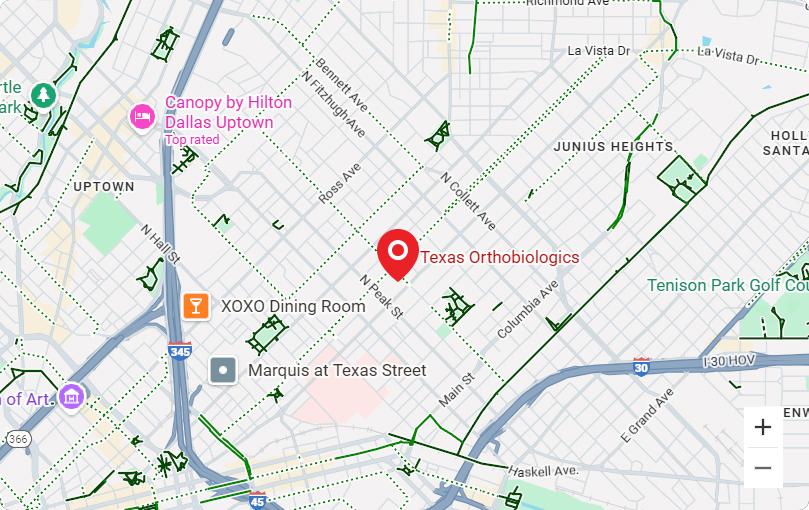
Texas Orthobiologics is at 3310 Live Oak, Suite 202, in Dallas. Call (877) 777-8883 or request a visit online.
Areas We Serve
Our office is in Dallas, and patients come to us from across North Texas, including:
- Dallas and nearby: Highland Park & University Park, Irving, Richardson, Garland, Carrollton and Coppell
- Collin County: Plano, Frisco, McKinney, Allen and Prosper
- Northwest and Tarrant County: Grapevine, Southlake, Colleyville, Keller, Flower Mound and Fort Worth
Disclaimer: This article is for educational purposes only and is not medical advice. Individual results vary. PRP and BMAC (stem cells) are not FDA-approved treatments for back pain. Please talk with a qualified physician about your specific condition.
References
- GBD 2021 Low Back Pain Collaborators. Global, regional, and national burden of low back pain, 1990-2020, its attributable risk factors, and projections to 2050: a systematic analysis of the Global Burden of Disease Study 2021. Lancet Rheumatol. 2023;5(6):e316-e329. doi:10.1016/S2665-9913(23)00098-X. Abstract | Free full text
- Qaseem A, Wilt TJ, McLean RM, Forciea MA; Clinical Guidelines Committee of the American College of Physicians. Noninvasive treatments for acute, subacute, and chronic low back pain: a clinical practice guideline from the American College of Physicians. Ann Intern Med. 2017;166(7):514-530. doi:10.7326/M16-2367. Abstract
- Friedly JL, Comstock BA, Turner JA, et al. A randomized trial of epidural glucocorticoid injections for spinal stenosis. N Engl J Med. 2014;371(1):11-21. doi:10.1056/NEJMoa1313265. Abstract
- US Food and Drug Administration. FDA Drug Safety Communication: FDA requires label changes to warn of rare but serious neurologic problems after epidural corticosteroid injections for pain. Published April 23, 2014. Accessed November 6, 2026. https://www.fda.gov/drugs/drug-safety-and-availability/fda-drug-safety-communication-fda-requires-label-changes-warn-rare-serious-neurologic-problems-after
- Juch JNS, Maas ET, Ostelo RWJG, et al. Effect of radiofrequency denervation on pain intensity among patients with chronic low back pain: the Mint randomized clinical trials. JAMA. 2017;318(1):68-81. doi:10.1001/jama.2017.7918. Abstract | Free full text
- Fischgrund JS, Rhyne A, Franke J, et al. Intraosseous basivertebral nerve ablation for the treatment of chronic low back pain: a prospective randomized double-blind sham-controlled multi-center study. Eur Spine J. 2018;27(5):1146-1156. doi:10.1007/s00586-018-5496-1. Abstract
- Mannion AF, Brox JI, Fairbank JC. Comparison of spinal fusion and nonoperative treatment in patients with chronic low back pain: long-term follow-up of three randomized controlled trials. Spine J. 2013;13(11):1438-1448. doi:10.1016/j.spinee.2013.06.101. Abstract
- Park D, Lee WR, Bang M, Park SJ, Kim JH, Kim HS. Incidence and preoperative risk factors for failed back surgery syndrome: a nationwide population-based cohort study. Sci Rep. 2026;16(1). doi:10.1038/s41598-026-55626-2. Abstract | Free full text
- Mishra A, Pavelko T. Treatment of chronic elbow tendinosis with buffered platelet-rich plasma. Am J Sports Med. 2006;34(11):1774-1778. doi:10.1177/0363546506288850. Abstract
- Alatefi D, Alkabazi M, Alanzi A, et al. Platelet-rich plasma versus corticosteroid injections for facet and sacroiliac joint pain: a systematic review and meta-analysis with trial sequential analysis. Pain Med. 2026;27(10):1108-1122. doi:10.1093/pm/pnag072. Abstract
- Manchikanti L, Abd-Elsayed A, Jin MY, et al. A systematic review and meta-analysis of randomized controlled trials of epidural regenerative medicine therapies in managing spinal pain. Curr Pain Headache Rep. 2026;30(1). doi:10.1007/s11916-025-01448-2. Abstract
- Navani A, Manchikanti L, Albers SL, et al. Responsible, safe, and effective use of biologics in the management of low back pain: American Society of Interventional Pain Physicians (ASIPP) guidelines. Pain Physician. 2019;22(1S):S1-S74. Abstract
Don Buford, MD is a board certified orthopedic surgeon. That matters here because the same physician who can offer you an orthobiologic injection can also tell you honestly when an injection is not the right answer and an operation is. A clinic that cannot perform the surgery has no way to make that comparison.
Common questions
- Do you inject the discs in the spine?
- No. We don't do disc injections. Depending on your diagnosis, we treat the facet joints, the SI joints, the ligaments of the low back, the epidural space around the spinal nerves, or the piriformis muscle, after finding exactly where your pain is coming from.
- Can I still be treated if I've already had steroid shots, an ablation or back surgery?
- Often, yes. Many of our back pain patients have already tried those options. We'll review your full history and imaging and tell you honestly whether PRP or BMAC (stem cells) makes sense for you, and what your investment would be.
- How long does treatment take, and when will I know if it's working?
- PRP and BMAC (stem cells) visits each take about an hour in our Dallas office, and you go home the same day. Orthobiologics are not a quick fix. Your body's response builds over weeks, not days, and every patient is different.