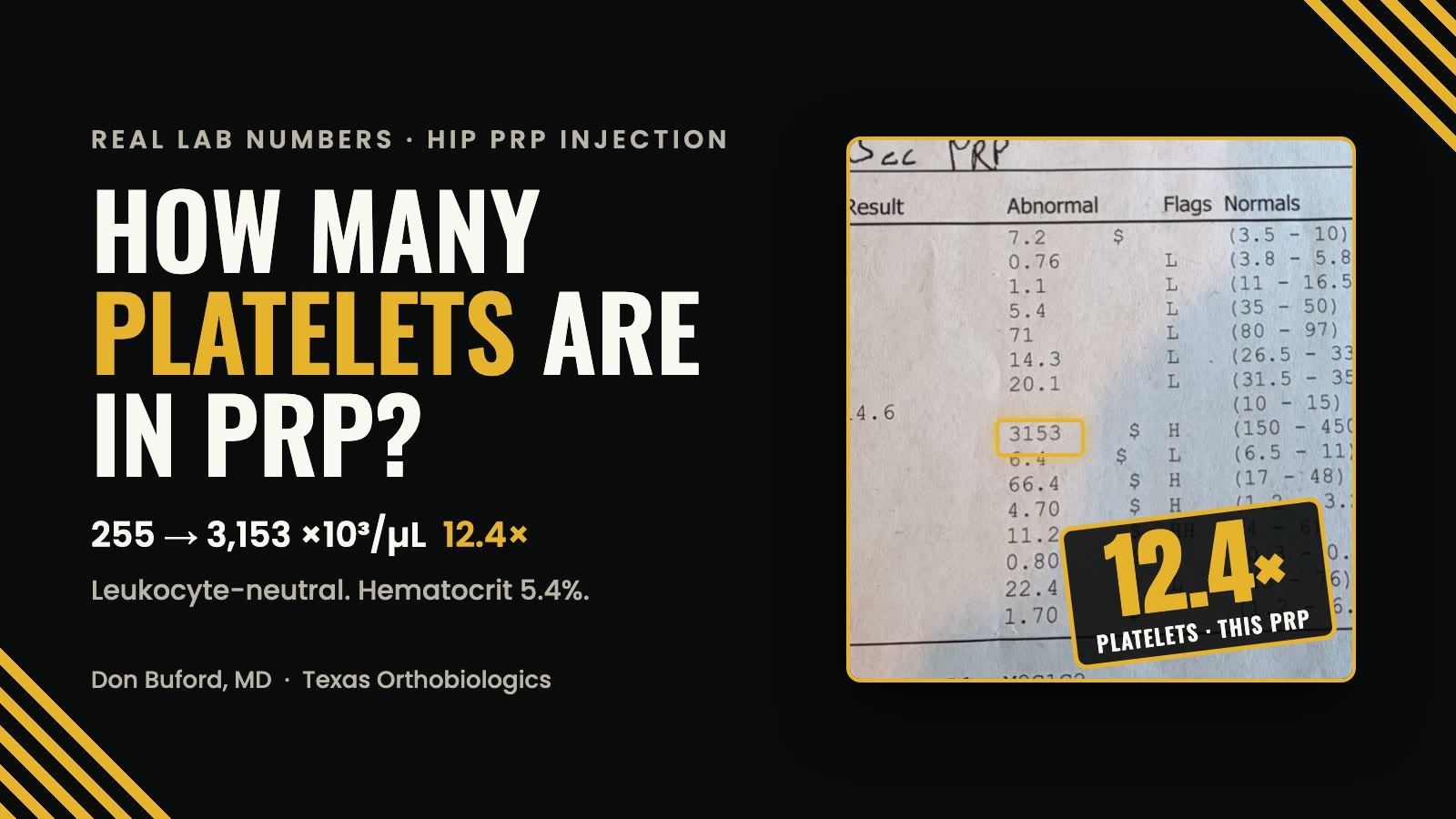
Real lab numbers from a real ultrasound-guided hip PRP injection, and how we make sure the shot reaches the joint. From Don Buford, MD, seeing patients from Dallas, Plano and Southlake.
Quick answer: In this patient's hip PRP injection, the platelet count rose from 255 to 3,153 ×10³/µL, about 12 times their blood level, or roughly 3 billion platelets per cc. White cells stayed near the blood level, and red cells dropped to a hematocrit of 5.4%.
Maybe it started as a deep ache in the groin when you get out of the car. Then it was putting on socks, or the first few steps in the morning. You have read about PRP, and you are thinking about a hip PRP injection. But there is a question many patients hold back, almost embarrassed to ask:
Will the shot even hit the spot?
It is a fair question. The hip joint sits deep, under muscle and fat, and you want to know the treatment actually gets where it needs to go. My answer is simple: we watch it.
Then comes the second question: what is actually in that shot? Below are the real lab numbers from one of our hip PRP injections, platelets, white cells and red cells, measured before and after.
Why the hip is hard to reach
Your knee or shoulder is fairly close to the skin. The hip is not. The ball-and-socket joint is several inches below the surface, wrapped in a capsule and surrounded by large muscles, nerves and blood vessels. Without imaging, the person giving the injection is estimating where the joint is from landmarks on the skin.
That is why every hip PRP injection we do is guided by ultrasound.
How we guide the needle with ultrasound
Here is what happens during an ultrasound-guided hip PRP injection in our clinic:
- The approach. We reach the hip from the front (an anterior approach), using a curved ultrasound transducer that can see deep into the joint.
- The needle. We use a thin 22-gauge, 3.5-inch spinal needle, long enough to reach the joint.
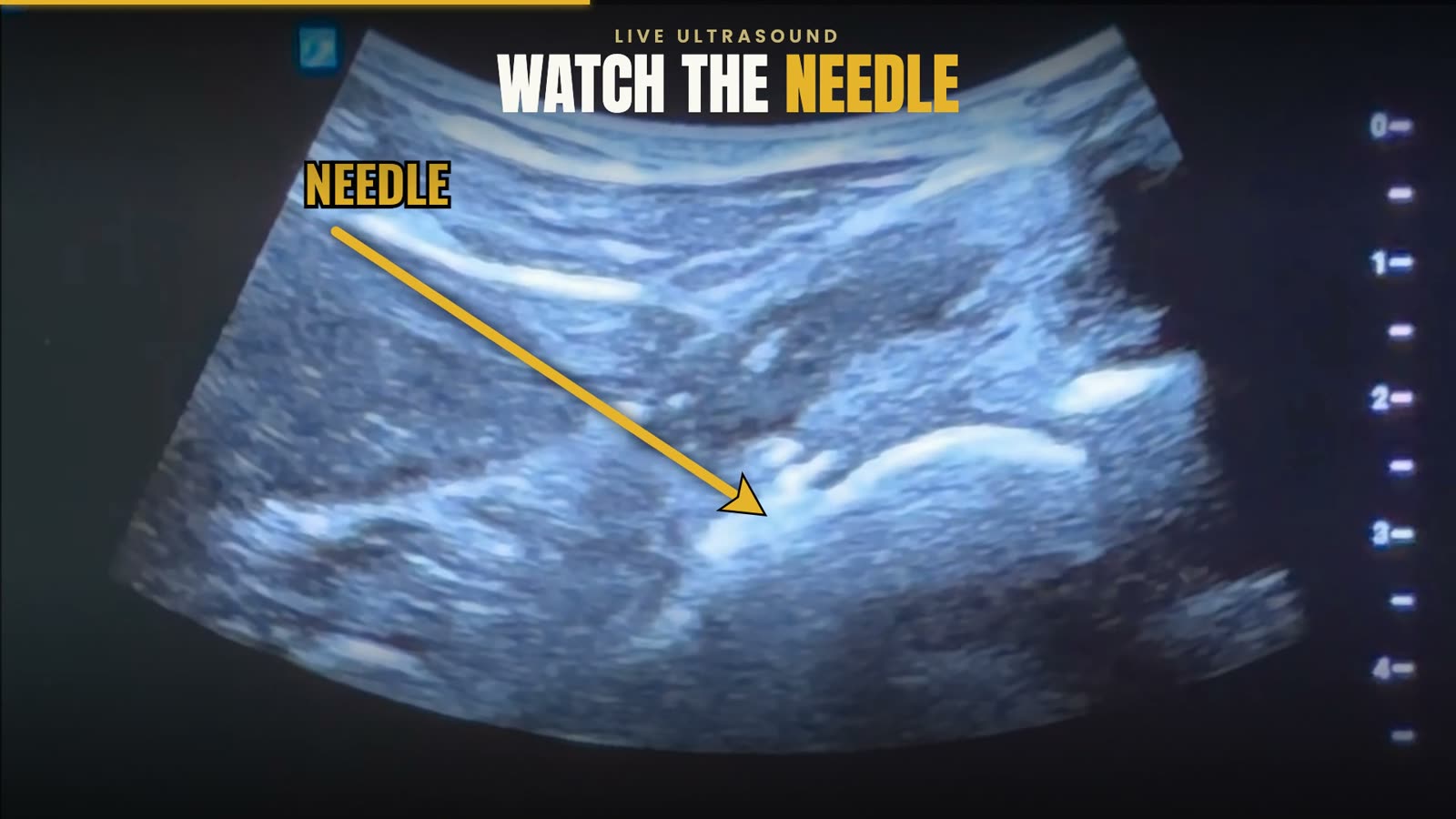
- Watching in real time. On the ultrasound screen, the needle shows up as a bright white line. I watch it move through the tissue, toward the joint, the whole way in.
- Confirming placement. Once the needle tip is inside the joint, we inject the PRP and watch where it goes.
You can watch a real injection, from start to finish, in the video at the top of this page.
How many platelets are in PRP? This patient's lab results
PRP stands for platelet-rich plasma. It is made from your own blood. Here is our protocol for a hip PRP injection:
- We draw 120 cc of your blood.
- We spin it twice in a two-spin system to concentrate the platelets and separate out most of the red cells.
- We prepare about 5 cc of PRP and inject 4 cc into the hip joint.
But "PRP" is not one standard product. Different systems and different protocols produce very different results. So we do something many patients have never heard of: we test the PRP on a hematology analyzer before we inject it, and compare it with the patient's own blood.
Here are the real results from the patient in the video, shared with permission:
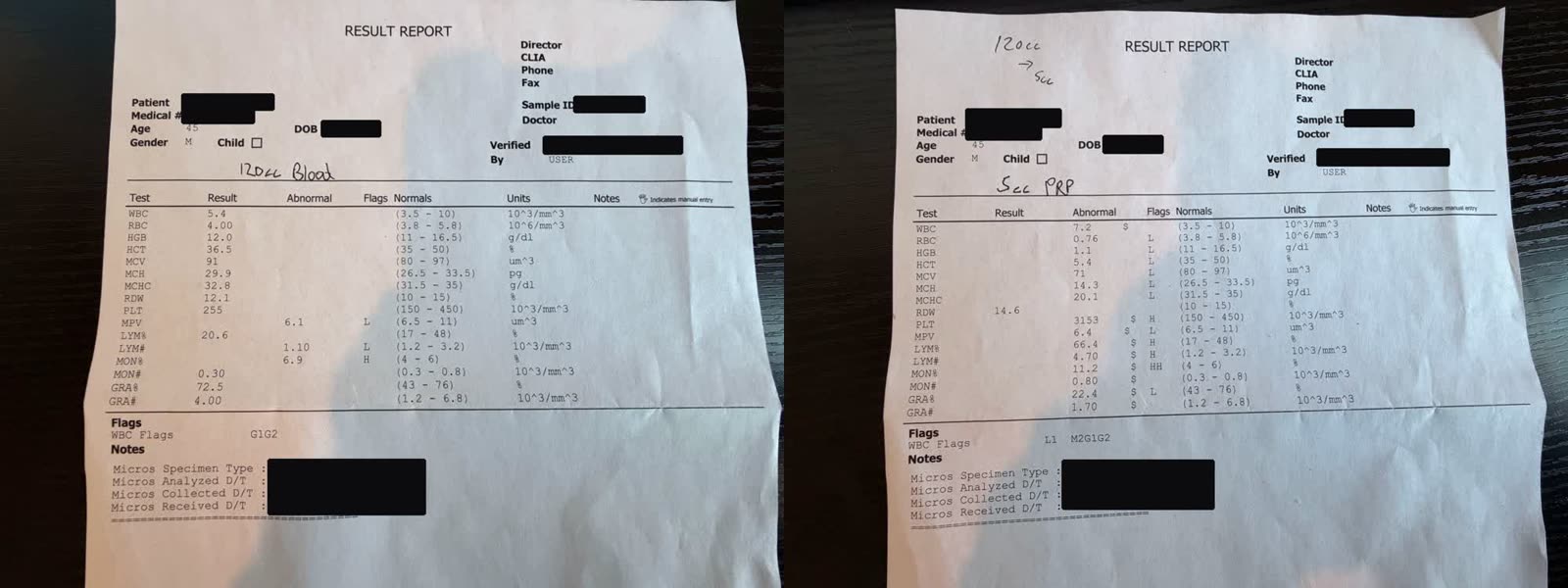
- Platelets: 255 in the blood, 3,153 in the PRP (×10³/µL). That is about 12 times more concentrated, or roughly 3 billion platelets in every cc.
- White blood cells: 5.4 in the blood, 7.2 in the PRP. That stayed close to the normal blood level, while the type of white cells shifted.
- Red blood cells: the hematocrit, the share of the sample made of red cells, dropped from 36.5% in the blood to 5.4% in the PRP. Most of the red cells were removed.
Platelet counts vary from person to person. A typical count in our PRP is about 2,500 to 3,500 (×10³/µL), or 2.5 to 3.5 billion platelets per cc, depending on the patient's starting count. Normal blood has about 0.15 to 0.45 billion per cc.
Testing does not guarantee a result. It does mean we know what we are giving you, instead of guessing.
For clinicians
If you are a physician or injector, I walk through the full hematology breakdown of this PRP (the white cell differential, absolute counts and red cell profile) in a short video for clinicians:

Watch the clinician breakdown on LinkedIn →
Is a hip PRP injection right for you?
PRP is not for everyone. We talk with patients about hip PRP when they are dealing with hip pain or hip arthritis and want to understand their options. The right choice depends on your exam, your imaging, your activity goals and your overall health. That conversation happens in person, before any injection.
Schedule a hip PRP consultation
We see patients from Dallas, Plano, Southlake and across North Texas. If you are wondering whether a hip PRP injection is right for you, call (877) 777-8883 or visit TexasOrthobiologics.com.
Results vary and are not guaranteed. This article is for education only and is not medical advice. Patient results shared with the patient's permission; identifying information removed.
Texas Orthobiologics measures its own PRP and bone marrow concentrate in the office with a hematology analyzer, so the dose given is a known number rather than an assumption. Very few practices measure anything at all.
Common questions
- How many platelets are in PRP?
- It depends on the system used and the patient's starting platelet count. At Texas Orthobiologics, a typical PRP count is 2,500 to 3,500 ×10³/µL, or about 2.5 to 3.5 billion platelets per cc, compared with about 0.15 to 0.45 billion per cc in normal blood. In one hip PRP injection, platelets rose from 255 to 3,153 ×10³/µL, about 12 times the patient's blood level.
- Why use ultrasound for a hip PRP injection?
- The hip joint sits several inches below the skin, under large muscles, so without imaging the injector is estimating where the joint is. With ultrasound guidance, the needle shows up as a bright white line in real time, so the physician can watch it reach the hip joint before injecting the PRP. Ultrasound also uses no radiation.
- Is all PRP the same?
- No. Platelet, white blood cell and red blood cell levels vary widely between PRP systems and protocols. Texas Orthobiologics tests its PRP on a hematology analyzer before injecting it; in one hip injection, the PRP had 12.4 times the blood platelet count, white cells near the blood level, and a hematocrit of 5.4%.