Almost every week, a patient asks me about BPC-157. Sometimes it's TB-500, or the two together, which social media calls the "Wolverine stack." They heard about it on a podcast, saw it on Instagram, or a friend at the gym swears by it.
Then on October 30, 2026, the US Department of Health and Human Services (HHS) published a new policy that lets pharmacies make six of these peptides again.1 Headlines said peptides are "legal now." That's not quite right, and the details matter if you're thinking about using one.
I'm a board-certified orthopedic surgeon and the 2026-2027 Chairman of the Biologic Association. I spend my days with tendon, ligament and joint injuries, which is exactly where these peptides are being marketed. Here's what actually changed, what the research shows, and how to protect yourself.
What Are Peptides?
Peptides are short chains of amino acids, the building blocks of proteins. Your body makes thousands of them. Some are already FDA-approved medicines, such as insulin and the GLP-1 drugs used for diabetes and weight loss.
The peptides in today's news are different. None of them is FDA-approved for any use.1 The six named in the new policy are:
- BPC-157, a lab-made piece of a protein found in stomach juice, promoted for tendon, ligament and gut healing
- TB-500, a fragment of a natural protein called thymosin beta-4, promoted for injury recovery
- KPV, promoted for inflammation
- MOTS-c, promoted for metabolism
- Semax, promoted for focus and memory
- Epitalon, promoted for aging and sleep
How We Got Here
The rules have changed several times in a short period:
- 2023: The FDA put BPC-157, TB-500 and other peptides on its "Category 2" list, meaning they raised significant safety concerns. Pharmacies were told not to make them.2 For BPC-157, the FDA cited a possible risk of immune reactions, problems with impurities, and little or no safety information in people.3
- April 2026: Twelve peptides came off the Category 2 list after the groups that nominated them withdrew their nominations. Coming off that list did not by itself allow pharmacies to make them.4
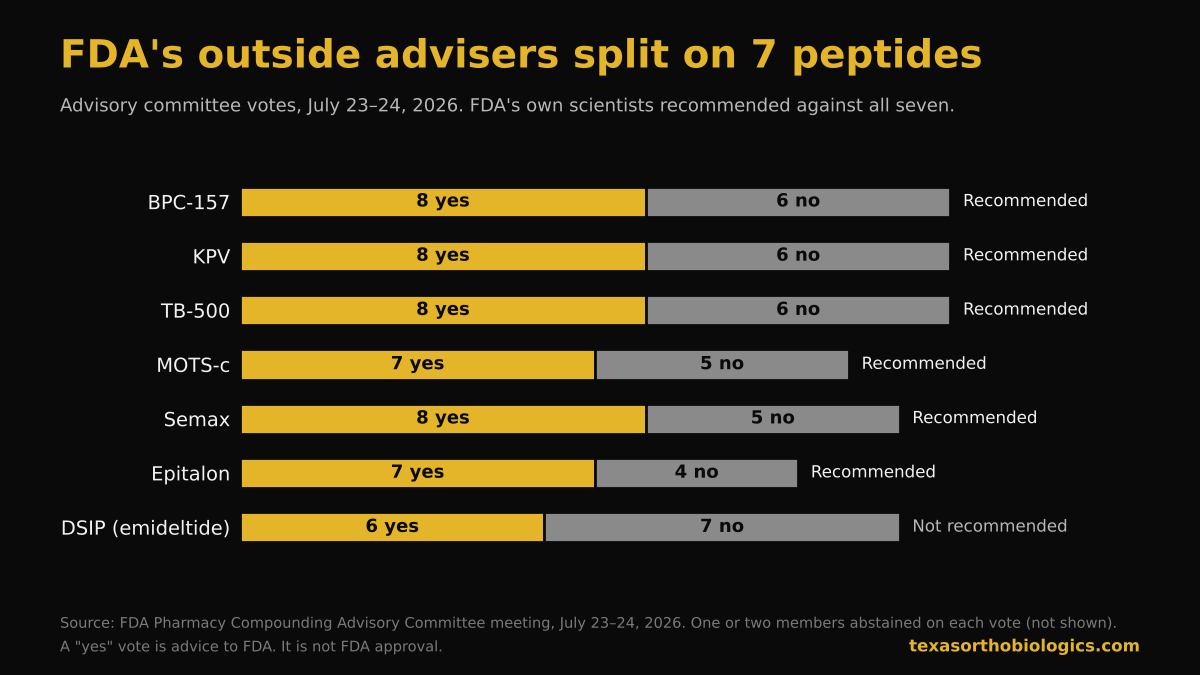
- July 23-24, 2026: The FDA's Pharmacy Compounding Advisory Committee, a panel of outside advisers, voted on seven peptides. It backed six by close votes and voted down one (DSIP). FDA's own scientists had recommended against all seven, saying the studies were too small and too short to show safety or effectiveness.5,6
- October 30, 2026: HHS published an "enforcement discretion" policy for the six peptides the panel backed.1 Public comments are due November 13, 2026.
- By February 2027: The advisers are scheduled to review five more peptides, including injectable GHK-Cu.4
What the New Policy Actually Says
"Enforcement discretion" means the government is choosing not to take action against something, for now. It is not a new law, and it is not FDA approval. The policy itself says compounded drugs are not FDA-approved and that HHS may change course if a safety or quality problem shows up.1
Under the policy, a state-licensed pharmacy or a licensed physician may compound one of the six peptides only if it follows a list of conditions. The main ones:1,7
- A prescription for a specific patient. No bulk sales and no "research use only" shortcuts.
- A traceable source. The raw peptide must come from an FDA-registered manufacturer, with a certificate of analysis showing what is in it.
- One peptide at a time. Each product can contain only one of the six. A premixed BPC-157 plus TB-500 "stack" in one vial does not meet the policy.
- Only certain routes. Each peptide is covered only in the ways the policy lists. BPC-157 is listed for injection under the skin or into a muscle, by mouth, or on the skin. TB-500 is listed only for injection under the skin or into a muscle.13 Injections into a joint or around a tendon are not on the list.
- Safety reporting. Serious side effects and quality problems must be reported to the FDA.
- Clear labeling. The label must say it is a compounded drug and not for resale.
The policy is also temporary. It lasts until the FDA finishes formal rulemaking on each peptide, and that process takes time.7 Some patient-safety groups have already asked the FDA to block it.8
What Does the Research Show?
This is the part that gets lost on social media. Most of what we know about BPC-157 comes from animal and lab studies.
A 2025 systematic review in the HSS Journal looked at BPC-157 from an orthopedic sports medicine point of view. Of the 36 studies that met its criteria, 35 were in animals or the lab. Only one was in people.9 The animal studies on muscle, tendon, ligament and bone injuries are interesting. But animal results often don't hold up in humans, and the review found no clinical safety data.9
I found three published human studies of BPC-157. Together they include about 30 people:
- A chart review of 16 patients who had BPC-157 injected into the knee, with no comparison group.10
- A study of 12 women with a bladder condition, also with no comparison group.11
- A safety study of IV BPC-157 in 2 adults.12
None of these studies compared BPC-157 to a placebo, and none was large enough to find uncommon side effects. For TB-500, the FDA said it had not found any data on people being exposed to it.3
That doesn't mean these peptides can't work. It means we don't know yet. In orthopedics, we have learned the hard way that a treatment that helps rats heal a tendon may not help a 55-year-old runner.
My Advice If You're Considering a Peptide
- Get a diagnosis first. Shoulder pain could be a rotator cuff tear, arthritis, a pinched nerve or something else. A peptide can't fix a problem nobody has identified.
- Stay away from "research use only" products. Peptides sold online for research are not made for people, and the new policy does not cover them. You don't really know what is in the vial.
- Ask where it came from. If a clinic offers a peptide, ask which pharmacy made it, whether that pharmacy is state-licensed, and whether they can show the certificate of analysis.
- Be wary of "stacks" and joint shots. Under the new policy, each compounded product may contain only one peptide, and BPC-157 injections into a joint are not among the listed routes.13
- Tell all of your doctors. Your surgeon, primary care doctor and pharmacist should know about every peptide you use, especially before surgery.
- If you compete, check your sport's rules. BPC-157 is banned in professional sports, according to the 2025 review.9
Where Orthobiologics Fit
Patients usually ask about peptides because they want to heal an injury without surgery. I understand that goal, because it's the heart of what we do at Texas Orthobiologics.
We start with an exact diagnosis using an exam and ultrasound. Then we talk through every option, from physical therapy and strength work to orthobiologics and surgery. The orthobiologics we use are made from your own body:
- PRP (platelet-rich plasma) is made from your own blood. We measure the platelet dose in every PRP injection, so we know exactly what you are getting.
- BMAC (stem cells) stands for bone marrow aspirate concentrate. It is made from a small amount of your own bone marrow and concentrated in the office.
Every patient is different, and results vary. Whether any treatment is right for you depends on your diagnosis.
For background on how compounding pharmacies and the FDA's categories work, see my earlier post, The Truth About Peptides, Compounding Pharmacies, and FDA Regulation.
The Bottom Line
The October 2026 HHS policy makes six peptides easier to get from a licensed pharmacy, with a prescription and quality checks. It does not make them FDA-approved, and it does not prove they are safe or effective.
Here is my take. We still have no human dosing studies and no human outcome studies for these peptides. That means any doctor prescribing them is making an educated guess about the dose. Even worse, it's only a guess which orthopedic conditions a peptide might help, and which ones it might actually hurt while they heal.
I need more certainty than that for my patients. That's why I don't offer peptides at Texas Orthobiologics. When there are other safe options with real human research behind them, there is no need to rush to a drug that is unapproved and unproven.
If you have a tendon, ligament or joint injury and you're wondering about peptides, PRP or BMAC (stem cells), come talk with us. Texas Orthobiologics is at 3310 Live Oak, Suite 202, in Dallas. Call our office or request a visit online.
Found this helpful? Like and follow Texas Orthobiologics on social media for clear, research-based updates on regenerative medicine.
Disclaimer: Individual results vary. This article is for educational purposes only and is not medical advice. Peptides discussed here are not FDA-approved. Please talk with a qualified physician about your specific condition.
References
- US Department of Health and Human Services. Enforcement discretion policy regarding 503A compounding using certain peptide bulk drug substances. Fed Regist. Published October 30, 2026. Docket HHS-OASH-2026-0496. https://www.govinfo.gov/content/pkg/FR-2026-10-30/pdf/2026-22192.pdf
- US Food and Drug Administration. Bulk drug substances used in compounding under section 503A of the FD&C Act. Accessed November 3, 2026. https://www.fda.gov/drugs/human-drug-compounding/bulk-drug-substances-used-compounding-under-section-503a-fdc-act
- US Food and Drug Administration. Certain bulk drug substances for use in compounding may present significant safety risks. Updated April 22, 2026. Accessed November 3, 2026. https://www.fda.gov/drugs/human-drug-compounding/certain-bulk-drug-substances-use-compounding-may-present-significant-safety-risks
- Frier Levitt. FDA to remove 12 popular peptides from the Category 2 "do not compound" list. Published April 16, 2026. Accessed November 3, 2026. https://www.frierlevitt.com/articles/fda-peptides-do-not-compound-list-update-2026/
- McDermott Will & Schulz. Bulk-list bound? PCAC backs majority of peptides in two-day public meeting. Accessed November 3, 2026. https://www.mcdermottlaw.com/insights/bulk-list-bound-pcac-backs-majority-of-peptides-in-two-day-public-meeting/
- FDA panel backs 6 peptides for compounding. AJMC. Published July 31, 2026. Accessed November 3, 2026. https://www.ajmc.com/view/fda-panel-backs-6-peptides-for-compounding
- Arnold & Porter. HHS announces draft enforcement discretion policy paving way for pharmacies to compound certain peptides while FDA rulemaking is pending. Published November 2026. Accessed November 3, 2026. https://www.arnoldporter.com/en/perspectives/advisories/2026/11/hhs-announces-draft-enforcement-discretion-policy-paving-way-for-pharmacies
- 5 things to know about HHS's interim peptide compounding policy. AJMC. Published October 29, 2026. Accessed November 3, 2026. https://www.ajmc.com/view/5-things-to-know-about-hhs-s-interim-peptide-compounding-policy
- Vasireddi N, Hahamyan H, Salata MJ, et al. Emerging use of BPC-157 in orthopaedic sports medicine: a systematic review. HSS J. 2025;21(4):485-495. doi:10.1177/15563316251355551. Abstract | Free full text
- Lee E, Padgett B. Intra-articular injection of BPC 157 for multiple types of knee pain. Altern Ther Health Med. 2021;27(4):8-13. Abstract
- Lee E, Walker C, Ayadi B. Effect of BPC-157 on symptoms in patients with interstitial cystitis: a pilot study. Altern Ther Health Med. 2024;30(10):12-17. Abstract
- Lee E, Burgess K. Safety of intravenous infusion of BPC157 in humans: a pilot study. Altern Ther Health Med. 2025;31(5):20-24. Abstract
- Frier Levitt. HHS peptide compounding enforcement discretion policy. Published October 28, 2026. Accessed November 3, 2026. https://www.frierlevitt.com/articles/hhs-peptide-compounding-enforcement-discretion-policy/
Texas Orthobiologics measures its own PRP and bone marrow concentrate in the office with a hematology analyzer, so the dose given is a known number rather than an assumption. Very few practices measure anything at all.
Common questions
- Is BPC-157 legal now?
- Since October 30, 2026, HHS has said it will not take action against licensed pharmacies and physicians who compound BPC-157 under strict conditions, including a prescription for a specific patient and a traceable, tested ingredient. It is still not FDA-approved, and the policy is temporary while the FDA writes formal rules.
- Does the new policy mean peptides are proven safe and effective?
- No. The policy itself says compounded drugs are not FDA-approved. FDA's own scientists recommended against all seven peptides reviewed in July 2026, and the published human research on BPC-157 totals about 30 people in three small studies without placebo groups.
- Are "research use only" peptides sold online safe to inject?
- They are not made for people, and the new policy does not cover them. Without a licensed pharmacy, a prescription and a certificate of analysis, you can't be sure what is in the vial. Talk with a physician before using any peptide.