PRP and BMAC (stem cell) therapy are office procedures that use your own blood or bone marrow to treat a painful, arthritic hip. They are steps to consider when hip arthritis is getting in the way of your life and you are not ready for, or do not yet need, a hip replacement.
This page explains what each treatment is, who it may help, who it will not help, what the visit is like, and what the investment is. It is written by a board-certified orthopedic surgeon.
First, is it really the hip joint?
Hip pain is not one diagnosis. Where it hurts is a strong clue.
- Groin pain usually points to the hip joint itself, including arthritis.
- Pain on the outside of the hip often comes from the gluteal tendons. This is commonly missed, and it is treated differently from arthritis.
- Buttock pain can come from the low back or the sacroiliac joint.
Finding the true source is the first job of the visit. An injection placed well into the wrong problem is still the wrong treatment.
What PRP and BMAC (stem cells) are
PRP (platelet-rich plasma) is made from a sample of your blood. The platelets are concentrated in the office and placed into the hip. Platelets carry growth factors and signaling proteins the body uses in healing.
BMAC (bone marrow aspirate concentrate) is made from a small amount of bone marrow drawn from the back of your pelvis. People call it "stem cell therapy" because bone marrow contains stem cells. Stem cells are only a small share of what is in BMAC (stem cells). Most of it is other helpful cells and signaling proteins.
Only your own tissue is used. Texas Orthobiologics does not use fat-derived, umbilical cord, amniotic or exosome products.
How the options compare
| Option | What it is | Where it is done | Good to know |
|---|---|---|---|
| Therapy and activity changes | Guided exercise and load management | Home and clinic | Worth a fair try first |
| Steroid (cortisone) shot | An anti-inflammatory medicine | Office, a few minutes | Tends to work quickly and fade |
| PRP | Platelets concentrated from your own blood | Office, about one hour | Often the first biologic step |
| BMAC (stem cells) | Cells concentrated from your own bone marrow | Office, about one hour | Discussed for more advanced arthritis; a larger investment |
| Hip replacement | Surgery to replace the joint | Hospital or surgery center | The right answer for a hip that is truly worn out |
Hip arthritis has been studied less than knee arthritis, and it would be misleading to say the evidence is the same. No injection regrows a joint surface. The goal is less pain and better function, and results vary from person to person.
Who may be a candidate
- Hip arthritis confirmed on X-rays, with pain felt mostly in the groin
- Pain with walking, stairs, putting on shoes, or sleep
- Therapy and other care have not given enough relief
- A hip that still moves reasonably well
- Someone who wants to stay active and put off surgery if that is reasonable
Who is usually not a candidate
- A hip that is bone on bone, very stiff, or changing shape
- Pain that is really coming from the back, the sacroiliac joint or the tendons
- An active infection
If your hip is in this group, you will be told so at the visit and referred appropriately, not sold an injection. Dr. Buford does not perform hip replacement.
Your procedure, step by step
- Exam and imaging. Dr. Buford examines your hip and back, reviews your X-rays and looks at the hip with ultrasound.
- Collection. For PRP, blood is drawn from your arm. For BMAC (stem cells), the back of your pelvis is numbed and a small amount of marrow is drawn.
- Concentration. The sample is concentrated in the office.
- Injection. The treatment is placed into the hip under ultrasound guidance. The hip joint is deep, so seeing the needle matters.
The whole visit takes about one hour. You go home the same day.
After the procedure
- Soreness is common for up to 48 hours and then settles.
- Tylenol is fine. Avoid aspirin, ibuprofen and naproxen, because they may work against the treatment.
- Avoid hard exercise and sports for about one week.
- Follow-up visits are scheduled so your progress can be tracked.
What to expect
More than 90% of our procedures need only one injection (Texas Orthobiologics registry data, 2022 to 2026). We calculate the dose for every procedure and record it in our registry.
Change after a biologic injection is usually gradual. It tends to build over weeks to months, not days. Some people get a great deal of relief, some get a moderate amount, and some do not improve. Nobody can promise a result.
Hear from a patient
This is a real patient of Dr. Buford, about a year and a half after PRP injections in both hips. She was not paid. Her experience is her own, and results vary.
Your investment
Most insurance plans, Medicare and Medicaid do not currently cover orthobiologic treatment. At Texas Orthobiologics, the investment for a high-dose single-injection PRP treatment starts at $1,500, and for BMAC (stem cells) at $5,000. More detail is on our investment page.
What you are quoted includes the follow-up care that normally goes with the procedure. For patients who qualify, Cherry offers payment plans up to 3 months interest-free, and CareCredit offers financing plans up to 12 months with no prepayment penalties.
Why see an orthopedic surgeon for this
Don Buford, MD is a board-certified orthopedic surgeon, Chairman of the Biologic Association and a past President of the Interventional Orthobiologics Foundation. He performs every injection himself and teaches these techniques to other doctors.
That matters for one simple reason. If an injection is unlikely to help your hip, he will tell you so.
Common questions
Can PRP or BMAC (stem cells) regrow cartilage in my hip?
No. No injection available today has been shown to regrow a joint surface. The goal of treatment is less pain and better function. Results vary from person to person.
Is my hip pain really arthritis?
Not always. Pain on the outside of the hip often comes from the gluteal tendons, not the joint. Pain in the buttock can come from the low back or the sacroiliac joint. True hip joint pain is usually felt in the groin. Sorting this out is the first job of the visit, because each one is treated differently.
Should I start with PRP or with BMAC (stem cells)?
For many hips, PRP is the first step. It is a smaller procedure with a smaller investment. BMAC (stem cells) is usually discussed when the arthritis is more advanced or when PRP has not given enough relief. Dr. Buford will tell you which one fits your hip and why.
How many injections will I need?
More than 90% of our procedures need only one injection (Texas Orthobiologics registry data, 2022 to 2026), because we use high-dose PRP and measure the dose in every procedure.
Why does ultrasound guidance matter for the hip?
The hip joint is deep and cannot be felt from the skin. Ultrasound lets Dr. Buford see the needle and the joint, so the treatment goes where it is meant to go.
How long does the procedure take?
PRP and BMAC (stem cells) procedures each take about one hour in the office. You go home the same day.
What if my hip is too worn for an injection?
Then you should be told that plainly. A hip that is bone on bone, very stiff or changing shape is usually better served by hip replacement. Dr. Buford does not perform hip replacement. If that is your situation, you will be told at the visit and referred to a hip replacement surgeon.
Does insurance cover PRP or BMAC (stem cells) for the hip?
In most cases, no. Most United States insurance plans, Medicare and Medicaid do not currently cover orthobiologic treatment. At Texas Orthobiologics, the investment for a high-dose single-injection PRP treatment starts at $1,500, and for BMAC (stem cells) at $5,000. That includes the follow-up care that normally goes with the procedure.
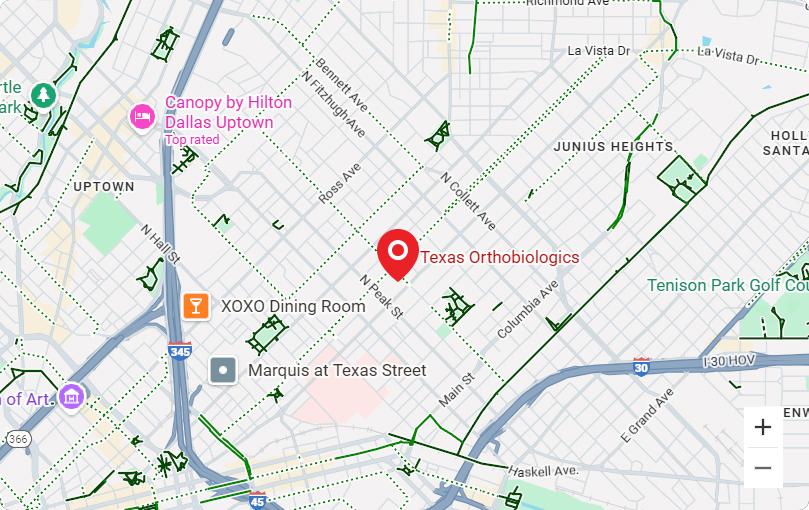
Request an appointment or call (877) 777-8883. Office visits in Dallas and telemedicine calls are available.
This page is general education, not medical advice. Results vary.