A PRP injection uses platelets from your own blood to treat a painful, arthritic knee. It is done in the office in about an hour, and for many knees it is the first biologic treatment to consider.
This page explains what PRP is, why the dose matters, who it may help, what the visit is like, and what the investment is. It is written by a board-certified orthopedic surgeon who does both injections and surgery.
What PRP is
PRP stands for platelet-rich plasma. Platelets are small cells in your blood. They carry growth factors and other signaling proteins that the body uses in healing.
To make PRP, a sample of your blood is drawn from your arm and spun in a centrifuge in the office. This separates and concentrates the platelets. The concentrated platelets are then placed into your knee the same day. Nothing is added from a donor.
Why the dose matters
All PRP is not the same. The number of platelets in an injection can differ a great deal from one clinic to the next, depending on how much blood is drawn and how it is prepared. A low-dose injection and a high-dose injection are both called "PRP," but they are not the same treatment.
More than 90% of our procedures need only one injection (Texas Orthobiologics registry data, 2022 to 2026). That is because we use high-dose PRP. Some clinics use a lower dose and schedule three or more injections to try to reach the same result.
We calculate the platelet dose for every procedure and record it in our registry. That is not common practice, and it means you can be told the dose you received. Dr. Buford also teaches PRP dosing to other doctors. When you compare clinics, ask each one what platelet dose you will receive.
How the options compare
| Option | What it is | Where it is done | Good to know |
|---|---|---|---|
| Steroid (cortisone) shot | An anti-inflammatory medicine | Office, a few minutes | Tends to work quickly and fade |
| Hyaluronic acid (gel) shot | A thick fluid that supplements joint fluid | Office, a few minutes | Not a biologic; has its own research |
| PRP | Platelets concentrated from your own blood | Office, about one hour | The most studied biologic for knee arthritis and the usual first step |
| BMAC (stem cells) | Cells concentrated from your own bone marrow | Office, about one hour | Discussed for more advanced arthritis; a larger investment |
| Knee replacement | Surgery to resurface the joint | Hospital or surgery center | The right answer for a knee that is truly worn out |
Knee arthritis is where PRP has been studied the most. More than thirty Level 1 studies have compared PRP with cortisone and with hyaluronic acid injections. No injection regrows a joint surface. The goal is less pain and better function, and results vary from person to person.
Who may be a candidate
- Knee arthritis confirmed on standing X-rays
- Pain with walking, stairs, exercise or sleep
- Therapy, weight management or other injections have not given enough relief
- A knee that is still fairly straight and stable
- Someone who wants to stay active
Who is usually not a candidate
- A knee with major bowing or knock-knee deformity
- A knee that is unstable or gives way
- Pain that is really coming from the hip or the back
- An active infection
If your knee is in this group, you will be told so at the visit, and you will hear what would work better. More about how knee arthritis is examined is on the knee arthritis page.
Your procedure, step by step
- Exam and imaging. Dr. Buford examines your knee, reviews standing X-rays and looks at the joint with ultrasound.
- Blood draw. Blood is drawn from your arm, much like a lab test.
- Concentration. The blood is spun in a centrifuge in the office to concentrate the platelets. This takes less than 10 minutes.
- Injection. The PRP is placed into your knee under ultrasound guidance, so it goes where it is meant to go.
The whole visit takes about one hour. You walk out and go home the same day.
After the procedure
- Some soreness is expected and should ease quickly.
- Tylenol is fine. Avoid aspirin and anti-inflammatory medicines such as ibuprofen and naproxen, because they may block the effect of PRP.
- Avoid hard exercise and sports for about one week.
- You are re-checked after the injection so progress can be tracked.
What to expect
Change after PRP is usually gradual. It tends to build over several weeks, not days. Some people get a great deal of relief, some get a moderate amount, and some do not improve. Nobody can promise a result, and you should be careful with any clinic that does.
Hear from a patient
This is a real patient of Dr. Buford, two months after PRP injections for knee arthritis. She was not paid. Her experience is her own, and results vary.
Your investment
Most insurance plans, Medicare and Medicaid do not currently cover orthobiologic treatment. At Texas Orthobiologics, the investment for a high-dose single-injection PRP treatment starts at $1,500.
What you are quoted includes the follow-up care that normally goes with the procedure. For patients who qualify, Cherry offers payment plans up to 3 months interest-free, and CareCredit offers financing plans up to 12 months with no prepayment penalties.
Why see an orthopedic surgeon for this
Don Buford, MD is a board-certified orthopedic surgeon who performs the injections, the arthroscopic surgery and the cartilage procedures himself. He is Chairman of the Biologic Association and a past President of the Interventional Orthobiologics Foundation, and he teaches these techniques to other doctors.
That matters for one simple reason. If an injection is unlikely to help your knee, he can tell you so and offer what will.
Common questions
Can PRP regrow the cartilage in my knee?
No. No injection available today has been shown to regrow a joint surface. The goal of PRP is less pain and better function. Results vary from person to person.
Is PRP better than a cortisone shot for knee arthritis?
Knee arthritis is where PRP has been studied the most. More than thirty Level 1 studies have compared PRP with cortisone and with hyaluronic acid (gel) injections. Broadly, cortisone tends to work quickly and fade, while PRP tends to build more slowly and last longer.
How many PRP injections will I need?
More than 90% of our procedures need only one injection (Texas Orthobiologics registry data, 2022 to 2026), because we use high-dose PRP. Some clinics use a lower dose and schedule three or more injections to try to reach the same result. Dr. Buford will tell you if your knee calls for a different plan.
Is all PRP the same?
No. The number of platelets in a PRP injection can differ a great deal from one clinic to the next. At Texas Orthobiologics, the platelet dose is calculated for every procedure and recorded in our registry. Ask any clinic what platelet dose you will receive.
Does a PRP injection hurt?
The skin is numbed first, and the injection is guided by ultrasound. Most people feel pressure in the knee. Soreness for a day or two afterward is common.
How soon will I know if it is working?
Change after PRP is usually gradual. It tends to build over several weeks, not days. You are re-checked after the injection so progress can be tracked.
Does insurance cover PRP for knee arthritis?
In most cases, no. Most United States insurance plans, Medicare and Medicaid do not currently cover orthobiologic treatment. At Texas Orthobiologics, the investment for a high-dose single-injection PRP treatment starts at $1,500, and that includes the follow-up care that normally goes with the procedure.
What if PRP is not enough for my knee?
For more advanced arthritis, BMAC (stem cells) may be discussed. For a knee that is truly worn out, knee replacement may be the right answer. Dr. Buford is an orthopedic surgeon, so you will hear all of your options.
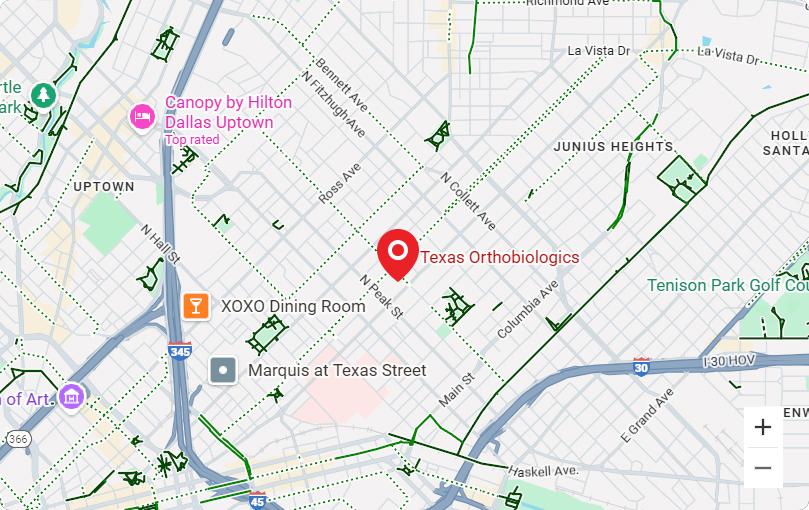
Request an appointment or call (877) 777-8883. Office visits in Dallas and telemedicine calls are available.
This page is general education, not medical advice. Results vary.
Related
- Knee arthritis treatment in Dallas
- BMAC (stem cell) therapy for knee arthritis
- PRP and BMAC (stem cell) therapy for meniscus tears
- Exosome therapy vs PRP vs BMAC (stem cells)
- Platelet-rich plasma (PRP) injections
- Knee surgery in Dallas
- PRP and BMAC (stem cell) investment
- Don Buford, MD — board-certified orthopedic surgeon