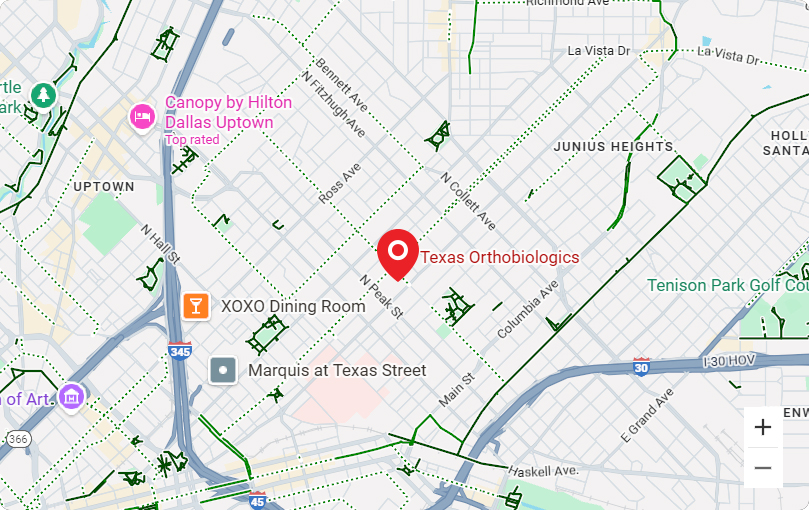
Low back pain is not one diagnosis, and that is the single most important thing to understand before considering any injection for it. The same pain in the same place can come from a facet joint, a sacroiliac joint, a gluteal tendon, a disc, or a nerve — and those are not treated the same way. At Texas Orthobiologics in Dallas, low back pain is assessed by a board-certified orthopedic surgeon before a biologic is considered, and PRP is offered only for the sources it can actually reach.
Spine biologics are the part of this field where the marketing runs furthest ahead of the evidence. Our orthobiologics page sets out what is real, what is not offered here, and why.
What we treat, and what we do not
All injections here are placed under ultrasound guidance. That is a real constraint and it is worth stating plainly rather than blurring, because it determines what is on the table.
Sources of low back pain we can treat
- Facet joint arthrosis — degenerative change in the small paired joints at the back of the spine
- Sacroiliac joint pain — frequently mistaken for lumbar pain, and a common source of one-sided pain low down and to the side
- Gluteal tendon problems — gluteus medius and minimus tendinopathy and partial tears, which refer pain into the low back and buttock and are routinely mislabelled as back pain
- Posterior ligamentous and paraspinal soft tissue pain
- Piriformis-related and deep gluteal pain
- Irritated lumbar nerve roots — treated by caudal epidural injection, described below
What is outside what we offer
- Intradiscal injections. Nothing is injected into a disc here.
- Transforaminal nerve root blocks and interlaminar epidurals. Those require fluoroscopic or CT guidance and are not performed here. The caudal epidural described below is a different route and is offered.
- Radiofrequency nerve ablation. Not performed here. It works by destroying the medial branch nerve, which regenerates over roughly six to eighteen months, after which it is repeated. It is a reasonable option for well-selected facet pain and we will refer you for it.
- Spine surgery. Dr. Buford does not perform it. If your problem turns out to be a disc herniation with nerve compression, spinal stenosis, or anything requiring a surgical spine opinion, you will be told and referred, not treated with an injection because an injection was what was available.
Further reading on specific diagnoses: chronic low back pain, disc herniation, sciatica and radiculopathy, back and spine overview.
The diagnosis is most of the work
Low back pain is where imaging is least useful on its own. Scan enough adults without back pain and you will find degenerative discs, facet change and bulges in a large share of them. A finding on an MRI is not automatically the source of your symptoms, and treating a finding instead of a source is why a lot of back pain treatment does not work.
What actually narrows it down is examination — where the pain is provoked, what position relieves it, whether it refers into the leg and how far, and whether the gluteal tendons are tender to direct palpation and under load. Ultrasound adds to that during the visit, particularly for the sacroiliac joint and the gluteal tendons.
Expect a consultation that spends more time on which structure is generating pain than on which product to inject. If that question cannot be answered with reasonable confidence, the right recommendation is not a biologic injection.
PRP for the low back
Platelet-rich plasma is a patient's own blood, spun down so that the platelets are concentrated into a small volume of plasma and everything unwanted is discarded. Platelets are best known for clotting, but they also carry a large reservoir of the growth factors and signalling proteins the body uses to recruit cells to an injury and start repair. PRP delivers a concentrated dose of that signal directly to the tissue that needs it.
Dr. Buford's assessment of the published work is that PRP has been shown to be effective in treating back pain arising from conditions including disc disease and facet arthrosis. Bone marrow concentrate has also been used for lumbar osteoarthritis. The evidence base for the spine is less mature than it is for the knee, and it would be misleading to present it as equivalent — so we will tell you what is reasonably supported for your particular source of pain and what is not.
What PRP is not, for the back: it is not a treatment for nerve compression, and it is not an alternative to a surgical opinion when one is needed.
Injections are performed under ultrasound guidance
Injections are placed under direct ultrasound guidance rather than by surface landmarks. The needle is visible on screen throughout, and the facet region, sacroiliac joint or tendon being treated is identified before anything is injected.
This matters more than it sounds. A blind injection relies on the anatomy being where the textbook says it is. Ultrasound shows where it actually is in the patient on the table that day, confirms the needle has reached the intended structure, and shows the injectate spreading where it was meant to go. When the treatment is a single dose of the patient's own concentrated biology, placing it accurately is not a refinement — it is the procedure.
Ultrasound also adds diagnostic information during the visit itself. Tendons can be examined dynamically, in motion and under load, which a static scan cannot show.
When bone marrow concentrate is considered
Bone marrow aspirate concentrate (BMAC) — the treatment usually marketed as a stem cell injection — is drawn from the patient's own posterior iliac crest in the office under local anesthetic, concentrated for about twenty minutes, and injected the same day.
It is a larger procedure than PRP and a considerably larger investment, so it is not simply the upgrade option. Worth knowing before you are quoted for it: mesenchymal stem cells are a small fraction of what concentrated marrow contains, and no injection available today has been shown to regrow a joint surface. Whether BMAC or PRP is indicated is decided on the tissue problem, the imaging and the prior response.
The four injections offered here
Platelet-rich plasma is the primary biologic in all four.
Facet joint injections
The facet joints are the small paired joints at the back of the spine that allow you to extend and rotate. They are a common and under-recognised source of low back pain, particularly in people whose pain is worse standing, walking and leaning backwards and better sitting or leaning forward. PRP is placed into or immediately around the painful joints. Where the diagnosis is uncertain, a diagnostic block first can confirm the facets are the pain source before anything biologic is committed to.
Sacroiliac joint injections
The sacroiliac joint transmits everything between spine and pelvis, and it is routinely blamed for pain it is not causing and routinely missed when it is. The presentation is characteristic: pain low and to one side, pointed at with a single finger, worse standing up out of a chair, rolling over in bed, or loading one leg at a time. The joint is deep, irregular and unforgiving of a landmark-guided needle, which is why image guidance is not optional here.
Caudal epidural injections
For pain that is coming from an irritated nerve root rather than from the back itself — pain travelling below the knee, often with numbness, tingling or weakness. The caudal approach enters the epidural space through the sacral hiatus, at the very bottom of the sacrum and well below the spinal cord. It is a long-established route with a good safety record and it is technically forgiving compared with approaches higher in the spine.
Piriformis and deep gluteal injections
Deep buttock pain that mimics sciatica closely and is frequently treated as sciatica for months without success. The tell is that it is usually worse with prolonged sitting and with the hip in particular rotated positions, and that the pain often does not follow a clean nerve distribution. These injections are performed under direct ultrasound guidance, which shows the muscle and the sciatic nerve in real time and keeps the needle away from the second while treating the first.
Our outcomes
This practice contributes prospectively to the DataBiologics IMPACT registry, a national orthobiologics outcomes registry. Treatments are entered whether they work or not, and patients are surveyed over time. For lumbosacral and pelvic PRP treatments performed here, 2021 through 2025:
- 154 cases tracked
- 68% reached the responder threshold — at least 50% improvement over their own baseline
- 91% patient satisfaction
- Zero serious treatment-related adverse events — 0 of 154
Because the registry records the platelet dose delivered and follows patients at set intervals, results can be separated by dose rather than averaged together. In this practice the higher-dose treatments are the ones associated with better relief and with relief that lasts longer.
Stated plainly, so it is not oversold: this is registry data, not a randomised trial. There is no control group and no blinding, and it reflects one practice and one physician. The full discussion — including the published trials that have not favoured spine PRP, and why we think dose explains the gap — is on the chronic low back pain page.
What happens after the injection
Depending on the area treated, crutches or upper-body immobilization may not be needed at all. When they are used, it is usually for about two days. Soreness can last up to 48 hours before it starts to settle.
Most patients have some soreness afterwards that decreases fairly quickly. Plan on avoiding significant physical activity or sport for about a week.
Do not take aspirin, ibuprofen, naproxen or other NSAIDs after the procedure. Anti-inflammatory medication blocks the inflammatory phase that the treatment is deliberately trying to start, so taking it works directly against the injection you just paid for. Acetaminophen (Tylenol) and other pain medicines that do not block inflammation are fine. If you take an NSAID or a blood thinner regularly for another condition, raise it before the procedure rather than after — it changes the plan.
Follow-up is scheduled rather than left to the patient to arrange. Progress is reviewed at intervals so the response can be judged against what was expected, and the plan adjusted if it is not tracking.
Your investment
Worth being direct about, because most sites are not: in the United States, most insurance plans, Medicare and Medicaid do not currently cover orthobiologic treatment. This is an investment you make in your own health rather than a benefit you claim, and you should expect a clear number rather than a vague one.
High-dose PRP
Nationally, the range for a high-dose, single-injection PRP treatment is $1,500 to $3,500.
Lower-dose PRP often requires multiple injections, and clinical outcomes are often not as good. That is why Texas Orthobiologics specializes in the higher-dose PRP protocols — one well-concentrated treatment placed accurately under ultrasound, rather than a series of weaker ones. It is also why the platelet concentration question above is worth putting to any provider you are comparing.
Bone marrow aspirate concentrate (a stem cell injection)
Nationally, the range is $5,000 to $13,000 for a single joint. Treating a second joint, or adding intra-osseous delivery into the bone, can take that as high as $19,900.
What the figure for an individual patient reflects:
- How many joints or sites are treated in one visit
- Which structure is involved — a joint, a tendon, or both
- The complexity of the treatment being planned
- Whether imaging or a diagnostic step is needed first to confirm the source of pain
What you are quoted includes the follow-up care that normally goes with the procedure. It is not a deposit against a series of further visits.
Every patient leaves the consultation with a clear understanding of the risks, the benefits and the potential investment before making any decision. Nobody is asked to commit to treatment at the visit.
CareCredit is available for patients who prefer to spread the investment over time. Interest rates are typically lower than regular credit card rates, and we offer financing plans up to twelve months in length. Our clinical specialists handle these questions directly, and it is worth speaking to them before you rule a treatment out — there are usually more options than are obvious from the outside.
To discuss the investment for your own treatment, call (877) 777-8883.
What we do not offer, and why
This field has a marketing problem, so rather than just listing exclusions it is worth stating the standard being applied.
We do not use any product that lacks a clear FDA regulatory pathway for use in humans and clear human clinical outcomes data showing that it is safe and that it works for the indication being treated. Both halves, not either one. That single sentence accounts for most of what is on the market and not on the menu here.
Amniotic fluid, Wharton's jelly, exosomes and regenerative protein arrays
These are marketed heavily, often as “stem cell” injections, and patients are frequently quoted a great deal of money for them. None of them is used here. There are two reasons, and the second matters more than the first.
The regulatory reason. The FDA regulates these products as biologic drugs. None of them currently holds an approved orthopedic indication. That is a description of their regulatory status rather than a matter of opinion, and it holds whatever a clinic's marketing says about it.
The evidence reason, which is the more significant one. Treatment here is based on evidence, and there is no published literature for any of these injectable allograft options in orthopedics showing that any of them works better than PRP or bone marrow concentrate. Not equivalent-but-cheaper, not better-in-a-subgroup — the comparison that would justify using them has not been made in their favour. PRP and bone marrow concentrate, by contrast, have a substantial published human literature behind them.
So even setting the regulatory question aside entirely, there is no evidence-based argument for choosing one of these over a treatment prepared from your own tissue.
Adipose (fat) based treatments, also called microfat
Texas Orthobiologics does not currently offer adipose-based orthobiologics. That is a practice decision, and it is worth separating from the regulatory picture, because the two kinds of adipose treatment are not in the same position.
Adipose preparations produced with a device carrying FDA clearance or approval are regulatory compliant. An adipose-based biologic is often called microfat, after the way clinicians in the United States must process the tissue. It is a legitimate orthobiologic option and some clinicians have success with it.
Treatments based on stromal vascular fraction — SVF — are not currently regulatory compliant. This is now settled, and it is worth being specific about how it got there, because clinics still advertise these injections.
In 2024 a federal appeals court held that SVF is a drug under federal law, and that it does not qualify for the same-surgical-procedure exception that same-day fat procedures had relied on. The Supreme Court declined to review that decision in 2025. On 28 August 2026 the district court entered a permanent injunction on remand in United States v. California Stem Cell Treatment Center, Inc., which also names Cell Surgical Network Corporation. That is not a warning letter or an opinion — it is a standing federal court order.
The practical meaning for a patient is simple. An SVF injection is an unapproved drug unless it goes through the drug approval pathway, whatever the clinic offering it advertises about same-day processing or minimal manipulation. That argument has been made, and it lost.
Every injection here is made from your own tissue
Every biologic injection performed at Texas Orthobiologics is autologous — prepared from the patient's own blood or bone marrow on the day of treatment.
That is deliberately a statement about injections rather than a blanket position on donor tissue. Donor cartilage used as a structural graft in cartilage transplantation surgery is a different proposition entirely: it is regulated under an established pathway, it is implanted rather than injected, and it carries decades of published human outcomes data. It meets the standard above. An injectable donor cell product does not.
What honest looks like here
Low back pain attracts more overtreatment than any other complaint in orthopedics, and regenerative medicine has contributed its share. Clinics sell multi-level injection packages, stem cell "protocols" for degenerative discs, and courses of treatment paid for up front.
We do not sell packages, we do not use donor or amniotic products, and we do not offer exosomes. If your back pain is coming from a structure ultrasound can reach and a biologic is reasonable for it, that is what will be recommended. If it is not, you will be told at the visit — which is cheaper for you than finding out afterwards.
Request an appointment or call (877) 777-8883.
Common questions
Can PRP help low back pain?
It depends entirely on what is generating the pain. PRP can be appropriate for low back pain arising from facet arthrosis, sacroiliac joint pain, gluteal tendon problems and posterior soft tissue pain. It is not a treatment for nerve compression, and it is not an alternative to a surgical opinion when one is needed.
Do you inject PRP into a disc?
No. Nothing is injected into a disc at this practice, and intradiscal injection is not offered. Caudal epidural injections are performed — that is a different route, entering the epidural space through the sacral hiatus at the base of the sacrum, well below the spinal cord, and it is the treatment used here for pain coming from an irritated nerve root. Transforaminal nerve root blocks and interlaminar epidurals require fluoroscopic or CT guidance and are not performed here.
Does Dr. Buford perform spine surgery?
No. If your problem requires a surgical spine opinion — a disc herniation with nerve compression or spinal stenosis, for example — you will be told and referred rather than treated with an injection.
Could my back pain actually be coming from my hip?
Often, yes. Gluteus medius and minimus tendon problems refer pain into the low back and buttock and are routinely labelled as back pain. Sacroiliac joint pain is also frequently mistaken for lumbar pain. Both are assessed by examination and ultrasound during the visit.
My MRI shows degenerative disc disease. Is that my pain?
Not necessarily. Degenerative discs, facet change and bulges are common findings in adults with no back pain at all. A finding on a scan is not automatically the source of symptoms, which is why the examination matters more than the report.
How much does a PRP injection cost?
Nationally, the range for a high-dose single-injection PRP treatment is $1,500 to $3,500. Most United States insurance plans, Medicare and Medicaid do not currently cover orthobiologic treatment, so this is an investment in your own health. The figure for an individual patient reflects how many sites are treated and the complexity of the treatment, and includes the follow-up care that normally accompanies it. Every patient leaves the consultation with a clear understanding of the risks, the benefits and the potential investment before deciding. Call (877) 777-8883.
Can I take ibuprofen afterwards?
No. Aspirin, ibuprofen, naproxen and other NSAIDs block the inflammatory phase the injection is intended to start. Acetaminophen (Tylenol) is fine. Tell the office beforehand if you take an NSAID or a blood thinner regularly.
Who performs the injection?
Don Buford, M.D., a board-certified orthopedic surgeon, performs the injections personally and under ultrasound guidance.
Does the platelet dose really matter?
We think it is the most important variable, and it is the one most clinics do not measure. Two syringes both labelled PRP can differ tenfold in the platelets they actually deliver, depending on the kit, the spin protocol, the starting blood volume and your own platelet count. Here the dose is measured and recorded for every treatment, and outcomes are tracked prospectively in a national registry so results can be separated by dose rather than averaged together.
Why not just have a steroid injection?
Sometimes that is the right answer, particularly for severe acute nerve pain where the priority is bringing inflammation down fast, and we will say so. But corticosteroid has a cumulative cost — blood sugar, bone density, the HPA axis, local tissue effects — which is why the number you can have is limited. PRP has no such ceiling and produced no serious adverse events across 154 cases here. Trying it first forecloses nothing: steroid, ablation and surgery all remain available afterwards.
Related
- Platelet-rich plasma (PRP)
- Bone marrow concentrate (BMAC)
- Chronic back pain
- Class IV MLS laser therapy
- PRP and orthobiologics for the knee
- PRP and orthobiologics for the shoulder
- PRP and orthobiologics for the hip
- PRP and orthobiologics for the elbow
- PRP and orthobiologics for the wrist
- PRP and orthobiologics for the foot and ankle