If you have arrived here having searched for regenerative medicine or stem cell therapy, you are probably trying to answer one question: is there something that can be done for my joint short of surgery, and is any of it real?
The short answer is that some of it is very real, some of it is oversold, and a fair amount of what is marketed under this heading in the United States is not legal to sell for this purpose at all. This page is written to help you tell the difference, then point you at the treatment that fits your actual problem.
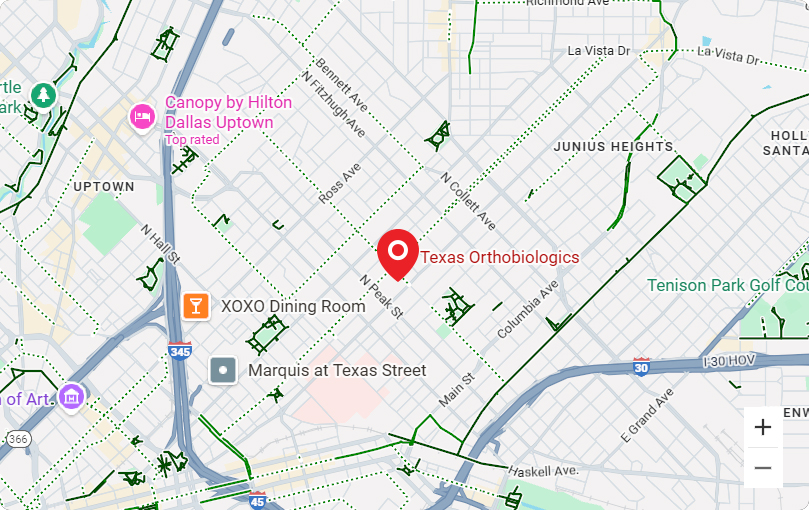
Everything described here is performed in Dallas by Dr. Don Buford, a board-certified orthopedic surgeon — not by a technician, a nurse injector or a chiropractor, which is worth checking wherever you go. Patients travel in from Plano, Frisco, McKinney, Fort Worth and across North Texas.
Start with the joint, not the product
The commonest mistake people make is shopping for a treatment before knowing what is wrong. Which biologic to use, and whether to use one at all, is decided by the diagnosis. Start where your problem is:
- Knee — the joint with the deepest randomised evidence behind biologic injection anywhere in orthopedics, and the one treated most here. Arthritis, meniscal problems, tendon pain, cartilage defects.
- Shoulder — rotator cuff pain and partial tears, instability, labral problems.
- Back and spine — facet joints, the sacroiliac joint, nerve-root pain and deep gluteal pain. Four image-guided injections, no spine surgery.
- Hip — arthritis, gluteal tendon tears, and the hip pain that turns out to be coming from the back.
- Elbow — tennis and golfer’s elbow, ligament problems.
- Hand and wrist — arthritis, ligament injury, tendon pain.
- Foot and ankle — arthritis, Achilles and plantar problems, ankle instability.
If you searched for “stem cell therapy,” read this first
This is the part of the field where the marketing runs furthest ahead of the science, and where the most money is lost.
What is legal and legitimate in the United States is your own tissue, used on you, in the same visit. That means bone marrow aspirate concentrate — marrow drawn from your own pelvis in the office, concentrated for about twenty minutes and injected the same day. It is the treatment that gets called a stem cell injection, and the honest description is more modest than the name: mesenchymal stem cells are a small fraction of what concentrated marrow actually contains.
What is not: amniotic fluid, umbilical cord and Wharton’s jelly products, placental tissue, and “exosome” preparations. These are donor-sourced, they are widely advertised across Dallas and Fort Worth, and they are not legal for this use in the United States. Any clinic offering you a stem cell injection out of a vial that came from someone else has a regulatory problem, whatever the brochure says. They are not offered here at any price.
Two more things worth knowing before you compare clinics:
- Nothing available today regrows a worn joint surface. Not PRP, not bone marrow concentrate, not fat, not any donor product. A biologic buys good years in a joint. It does not turn the clock back on one. Anyone promising regrown cartilage from an injection is selling something.
- Frozen or shipped “live cell” products are a red flag. If a product arrives on dry ice and is thawed in the room, ask what is actually alive in it and ask to see the human outcome data for your indication.
One rule decides all of it here. A product has to clear two bars before it goes into a patient: a legitimate FDA route for human use, and published human results showing it is safe and effective for the specific problem being treated. Clearing one bar is not enough, and most of what is advertised in this field clears neither.
What is actually used here
- Platelet-rich plasma (PRP) — your own blood, spun so the platelets are concentrated into a small volume. The workhorse, and the biologic with the most published evidence behind it. How much you get is the variable nobody checks. Ask two clinics for PRP and the number of platelets that ends up in your joint can differ by a factor of ten, depending on the kit, the spin, how much blood was drawn and your own blood count. This practice counts it and writes it down every time, and it is the subject of Dr. Buford’s published research.
- Bone marrow aspirate concentrate (BMAC) — the treatment usually marketed as a stem cell injection. A larger procedure and a considerably larger investment than PRP, so it is not simply the upgrade option to be chosen by whoever can afford it.
- Cartilage restoration — MACI, osteochondral allograft and the CartiHeal Agili-C implant, for a discrete cartilage defect in a joint that is otherwise sound. Surgical procedures rather than injections, and very few practices in the region perform them.
- Hyaluronic acid — not a biologic, but a viscous supplement to the joint fluid with its own place and its own evidence base.
For what each of these is, category by category, and what the evidence does and does not support, the detailed reference is the orthobiologics page.
Every injection is placed under ultrasound guidance
Not by feel, not by surface landmarks. The needle is visible on screen the whole way in, the target structure is identified before anything is injected, and the injectate is seen spreading where it was meant to go.
This is not a refinement. When the treatment is a single dose of your own concentrated biology, an injection that does not reach the target is simply a different treatment. Ultrasound also adds diagnostic information during the visit itself — tendons can be examined in motion and under load, which a static scan cannot show.
What it costs
Almost nobody publishes numbers for this, so here they are. Across the United States these treatments sit outside what commercial insurance, Medicare and Medicaid pay for. You are buying this, not claiming it — which means you are entitled to a figure before you decide, not after.
| Treatment | Typical national range |
|---|---|
| High-dose PRP, single injection | $1,500–$3,500 |
| Bone marrow concentrate (BMAC) | $5,000–$13,000 per joint |
Two notes on those ranges. Cheaper PRP is usually weaker PRP, sold as a course of three or four visits; the arithmetic often lands in the same place and the results reported in the literature are generally poorer. And BMAC sits that much higher because it is a bigger procedure, not because it is a premium tier of the same thing.
Where in the range you land turns on how many sites are treated at one sitting, which tissue is involved, and whether a diagnostic step is needed first to be sure of the target. Follow-up care that belongs to the procedure is included — you are not putting down a deposit against a series of return visits.
At the consultation you are given one figure for your own case, not a bracket, and you leave without being asked to decide. Call (877) 777-8883 to talk the numbers through beforehand. CareCredit is accepted, with interest rates typically lower than regular credit card rates and financing plans up to twelve months in length.
Who this is reasonable for — and who it is not
A biologic injection is worth considering when the pain has a specific, identifiable source, when rest and proper rehabilitation have been genuinely tried, and when the joint has enough structure left to be worth preserving.
It is not the right answer when:
- The joint surface is largely gone. At that point a biologic is being asked to do something it cannot do, and a surgical conversation is the honest one.
- The problem is mechanical — a knee that genuinely locks, a fragment blocking movement. No injection unblocks it.
- There is a structural narrowing compressing a nerve, with progressive weakness. That is a surgical assessment, urgently.
- Nobody can say with reasonable confidence which structure is generating the pain. Treating a finding on a scan rather than a source of symptoms is why a great deal of this treatment fails.
Being told no is part of the service. Dr. Buford performs surgery as well as injections, which means the recommendation can go either way — an injection-only clinic has one answer available to it, and a practice that does not offer biologics has another.
What the visit involves
- Examination first. Which structure is generating the pain is most of the work, and it decides what any imaging means rather than the other way round.
- Your own tissue, same day. Blood drawn for PRP, or marrow aspirated under local anesthetic for BMAC. Processed on site, injected in the same visit.
- A sore week is normal. The whole mechanism is a deliberate repair reaction, so the joint often complains louder before it settles. Skip ibuprofen and similar drugs while that is happening — damping the reaction down is the one thing you do not want to do.
- Judge it at six to twelve weeks. Cortisone tells you within days whether it worked; this does not, and treating it like a shot that failed at week two is the commonest way patients talk themselves out of a treatment that was working.
- Results are measured. This practice contributes prospectively to the DataBiologics IMPACT registry, a national outcomes registry. Treatments are entered whether they work or not, and patients are surveyed at set intervals.
Common questions
What is the difference between regenerative medicine, orthobiologics and stem cell therapy?
They overlap and are used loosely, which is part of the problem. Regenerative medicine is the broad consumer term. Orthobiologics is the precise one — biologic materials used for musculoskeletal problems, which is what is actually offered here. Stem cell therapy is a marketing term more often than a technical one; the legitimate version in the United States is bone marrow aspirate concentrate taken from your own body and used on you in the same visit. If a clinic uses the three interchangeably without ever telling you which specific product goes in the syringe, that is worth noticing.
Does regenerative medicine actually work, or is it hype?
Both, depending on which treatment and which problem. Knee osteoarthritis has the deepest randomised evidence for PRP anywhere in orthopedics, and it supports meaningful reduction in pain and improvement in function in well-selected patients. Other indications are less well supported and will be described that way here rather than sold as equivalent. What no treatment does — and this is where the hype lives — is regrow a worn joint surface.
How much does regenerative medicine cost in Dallas?
Expect $1,500 to $3,500 for a high-dose PRP injection and $5,000 to $13,000 for bone marrow concentrate in a single joint, and as much as $19,900 for two joints or with intra-osseous delivery into the bone. Those are the national ranges. None of it is paid for by commercial insurance, Medicare or Medicaid, so treat it as a purchase and insist on a number up front. Where you land depends mainly on how many sites are treated at once and how complex the target is. You will be quoted one figure at the consultation rather than a bracket, and you will not be asked to decide that day. CareCredit is accepted, with interest rates typically lower than regular credit card rates and financing plans up to twelve months in length.
Are stem cell injections from amniotic fluid or umbilical cord legal?
Not for this use in the United States. Amniotic fluid, umbilical cord and Wharton's jelly products, placental tissue and exosome preparations are donor-sourced and are not legal to sell as injectable treatments for orthopedic conditions, however widely they are advertised. They are not offered here at any price. If a clinic is injecting something that came from another person's tissue, ask what regulatory pathway it is being sold under.
Will an injection let me avoid joint replacement?
Sometimes it delays one meaningfully, and that is a reasonable goal to have. Sometimes the joint is too far gone for that to be realistic, and you will be told so rather than sold a treatment that cannot deliver it. Because Dr. Buford performs surgery as well as injections, the recommendation is not constrained by what the practice happens to sell — which is worth considering when comparing advice from a clinic that only offers one of the two.
Who performs the injection?
Dr. Buford performs every injection personally, under ultrasound guidance. He is a board-certified orthopedic surgeon. This is worth asking wherever you go — in a good deal of this field the consultation is with a physician and the injection is delegated to someone else.
How soon will I know if it worked?
Improvement builds over weeks rather than days, and a few days of increased soreness immediately afterwards is expected rather than a bad sign. Progress is reviewed at set intervals so the response can be judged against what was expected and the plan adjusted if it is not tracking. Outcomes are entered prospectively into a national registry whether they are good or not.
Do you see patients from outside Dallas?
Yes. Patients come from Plano, Frisco, McKinney, Fort Worth and across North Texas, and from further afield for cartilage restoration in particular, which few practices in the region offer.