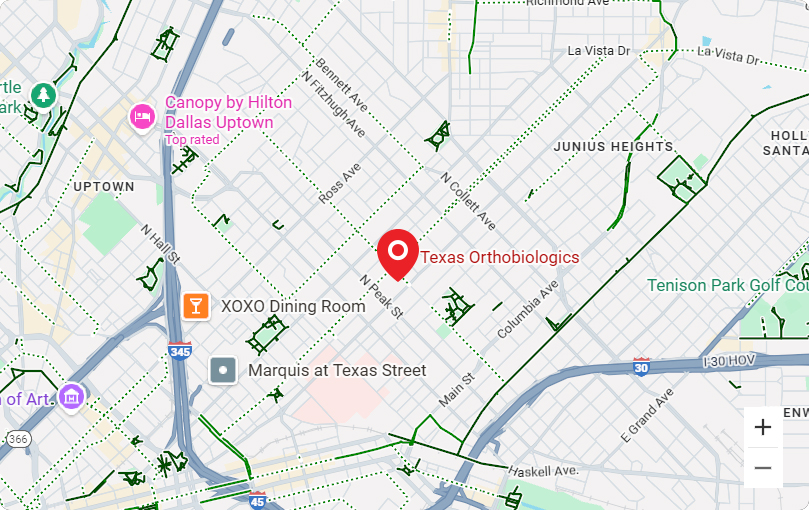
Plantar fasciitis and Achilles tendinopathy are two of the most common reasons anyone seeks out PRP, and both are well suited to it. They are load-bearing soft tissue problems in structures that sit close to the surface, which makes them straightforward to image and to inject accurately. At Texas Orthobiologics in Dallas, foot and ankle injections are performed under live ultrasound guidance by a board-certified orthopedic surgeon.
For the category as a whole rather than this region — including what orthobiologics can and cannot do for arthritis — see the main orthobiologics page.
Foot and ankle problems treated with orthobiologics
- Plantar fasciitis — including heel pain that has not settled with stretching, orthotics and time
- Achilles tendinopathy, mid-substance and insertional
- Peroneal tendinitis
- Tibialis posterior tendinitis
- Ankle osteoarthritis
- Foot and ankle arthritis, including midfoot and great toe
- Chronic ankle instability and ligament injury after repeated sprains
PRP for the foot and ankle
Platelet-rich plasma is a patient's own blood, spun down so that the platelets are concentrated into a small volume of plasma and everything unwanted is discarded. Platelets are best known for clotting, but they also carry a large reservoir of the growth factors and signalling proteins the body uses to recruit cells to an injury and start repair. PRP delivers a concentrated dose of that signal directly to the tissue that needs it.
Platelet concentration is the variable worth asking any provider about. Blood carries roughly 200,000 platelets per microliter; current evidence suggests PRP should approach or exceed 1,000,000 per microliter, about a five-fold concentration. PRP here is prepared in the office from blood drawn the same visit, with the centrifuge step taking under ten minutes.
Achilles tendon: an important caution
The Achilles is one place where what gets injected, and where, deserves particular care. An Achilles tendon under load has limited tolerance for anything that weakens it, and a tendon at risk of rupture is not a tendon to inject casually. Insertional and mid-substance Achilles problems also behave differently and are not interchangeable.
This is a reason to have the assessment done by someone who treats Achilles ruptures surgically as well as conservatively, because the judgement about which tendons to leave alone is the part that protects you.
When bone marrow concentrate is considered
Bone marrow aspirate concentrate (BMAC) — the treatment usually marketed as a stem cell injection — is drawn from the patient's own posterior iliac crest in the office under local anesthetic, concentrated for about twenty minutes, and injected the same day.
It is a larger procedure than PRP and a considerably larger investment, so it is not simply the upgrade option. Worth knowing before you are quoted for it: mesenchymal stem cells are a small fraction of what concentrated marrow contains, and no injection available today has been shown to regrow a joint surface. Whether BMAC or PRP is indicated is decided on the tissue problem, the imaging and the prior response.
Injections are performed under ultrasound guidance
Injections are placed under direct ultrasound guidance rather than by surface landmarks. The needle is visible on screen throughout, and the structure being treated is identified before anything is injected.
This matters more than it sounds. A blind injection relies on the anatomy being where the textbook says it is. Ultrasound shows where it actually is in the patient on the table that day, confirms the needle has reached the intended structure, and shows the injectate spreading where it was meant to go. When the treatment is a single dose of the patient's own concentrated biology, placing it accurately is not a refinement — it is the procedure.
Ultrasound also adds diagnostic information during the visit itself. Tendons can be examined dynamically, in motion and under load, which a static scan cannot show.
What happens after the injection
Most patients have some soreness afterwards that decreases fairly quickly. Plan on avoiding significant physical activity or sport for about a week.
Do not take aspirin, ibuprofen, naproxen or other NSAIDs after the procedure. Anti-inflammatory medication blocks the inflammatory phase that the treatment is deliberately trying to start, so taking it works directly against the injection you just paid for. Acetaminophen (Tylenol) and other pain medicines that do not block inflammation are fine. If you take an NSAID or a blood thinner regularly for another condition, raise it before the procedure rather than after — it changes the plan.
Follow-up is scheduled rather than left to the patient to arrange. Progress is reviewed at intervals so the response can be judged against what was expected, and the plan adjusted if it is not tracking.
Your investment
Worth being direct about, because most sites are not: in the United States, most insurance plans, Medicare and Medicaid do not currently cover orthobiologic treatment. This is an investment you make in your own health rather than a benefit you claim, and you should expect a clear number rather than a vague one.
High-dose PRP
Nationally, the range for a high-dose, single-injection PRP treatment is $1,500 to $3,500.
Lower-dose PRP often requires multiple injections, and clinical outcomes are often not as good. That is why Texas Orthobiologics specializes in the higher-dose PRP protocols — one well-concentrated treatment placed accurately under ultrasound, rather than a series of weaker ones. It is also why the platelet concentration question above is worth putting to any provider you are comparing.
Bone marrow aspirate concentrate (a stem cell injection)
Nationally, the range is $5,000 to $13,000, depending on how many joints are treated and the complexity of the treatment.
What the figure for an individual patient reflects:
- How many joints or sites are treated in one visit
- Which structure is involved — a joint, a tendon, or both
- The complexity of the treatment being planned
- Whether imaging or a diagnostic step is needed first to confirm the source of pain
What you are quoted includes the follow-up care that normally goes with the procedure. It is not a deposit against a series of further visits.
The figure for your own treatment is given plainly at the consultation — the investment for injecting one ankle with PRP is a single number, not a range, once we know what we are treating.
Every patient leaves the consultation with a clear understanding of the risks, the benefits and the potential investment before making any decision. Nobody is asked to commit to treatment at the visit.
CareCredit is available for patients who prefer to spread the investment over time. Interest rates are typically lower than regular credit card rates, and we offer financing plans up to twelve months in length. Our clinical specialists handle these questions directly, and it is worth speaking to them before you rule a treatment out — there are usually more options than are obvious from the outside.
To discuss the investment for your own treatment, call (877) 777-8883.
What we do not offer, and why
This field has a marketing problem, so rather than just listing exclusions it is worth stating the standard being applied.
We do not use any product that lacks a clear FDA regulatory pathway for use in humans and clear human clinical outcomes data showing that it is safe and that it works for the indication being treated. Both halves, not either one. That single sentence accounts for most of what is on the market and not on the menu here.
Amniotic fluid, Wharton's jelly and exosome products
These are considered unapproved drugs by the FDA and are not approved for any treatment indication. That is a description of their current regulatory status, not a matter of opinion, and it holds whatever the clinic marketing says.
Separately, and just as importantly, there is a significant lack of published human outcomes data for these products in orthopedics — a marked contrast with PRP and bone marrow concentrate, where the human literature is substantial. So both halves of the standard fail, and they are not used here.
Every biologic injection performed at Texas Orthobiologics is autologous — prepared from the patient's own tissue on the day of treatment.
That is deliberately a statement about injections, not a blanket position on donor tissue. Donor cartilage used as a structural graft in cartilage transplantation surgery is a different proposition entirely: it is regulated under an established pathway, it is implanted rather than injected, and it carries decades of published human outcomes data. It meets the standard above. An injectable donor cell product does not.
Adipose (fat) based treatments, also called microfat
An adipose-based biologic is known as microfat because of how clinicians in the United States must process the tissue. It is a different orthobiologic treatment option, and some clinicians have success with it. At Texas Orthobiologics we do not currently offer adipose or microfat based treatments.
A biologic is one option, not the only one
A consultation here is not a pre-decided route to an injection. Some presentations of foot and ankle pain respond well to an orthobiologic. Some do better with an operation. Some need physical therapy, a change in loading, or time, and would get neither benefit nor harm from a syringe.
Dr. Buford performs both the injections and the surgery, so the recommendation is not shaped by what happens to be on offer. If a biologic is unlikely to help your particular problem, you will be told that at the visit rather than after a course of treatment.
Request an appointment or call (877) 777-8883.
Common questions
Does PRP work for plantar fasciitis?
Plantar fasciitis is one of the more common indications for PRP, particularly heel pain that has not settled with stretching, orthotics and time. The plantar fascia sits close to the surface, which makes accurate ultrasound-guided placement straightforward.
Can PRP be used for Achilles tendinopathy?
Yes, though the Achilles warrants particular care. A tendon at risk of rupture is not a tendon to inject casually, and insertional and mid-substance problems behave differently. The assessment matters more here than the injection.
Do you treat ankle arthritis with injections?
Ankle osteoarthritis can be treated with PRP or bone marrow concentrate, depending on how advanced the joint change is. If a biologic is unlikely to help, you will be told that at the visit.
How much does a PRP injection cost?
Nationally, the range for a high-dose single-injection PRP treatment is $1,500 to $3,500. Most United States insurance plans, Medicare and Medicaid do not currently cover orthobiologic treatment, so this is an investment in your own health. The figure for an individual patient reflects how many sites are treated and the complexity of the treatment, and includes the follow-up care that normally accompanies it. Every patient leaves the consultation with a clear understanding of the risks, the benefits and the potential investment before deciding. Call (877) 777-8883.
Can I take ibuprofen afterwards?
No. Aspirin, ibuprofen, naproxen and other NSAIDs block the inflammatory phase the injection is intended to start. Acetaminophen (Tylenol) is fine. Tell the office beforehand if you take an NSAID or a blood thinner regularly.
Who performs the injection?
Don Buford, M.D., a board-certified orthopedic surgeon, performs the injections personally and under ultrasound guidance.
Is the injection made from my own tissue?
Yes. PRP is prepared from blood drawn at the same visit, and bone marrow concentrate from marrow drawn the same day. No donor material, birth tissue, adipose preparation or exosome product is used.
Related
- Plantar fasciitis — treatment in Dallas
- Platelet-rich plasma (PRP)
- Bone marrow aspirate concentrate (BMAC)
- PRP and orthobiologics for the knee
- PRP and orthobiologics for the shoulder
- PRP and orthobiologics for the hip
- PRP and orthobiologics for the elbow
- PRP and orthobiologics for the wrist
- PRP and orthobiologics for the foot and ankle
- PRP for low back pain
Foot and ankle problems treated here
The foot and ankle carry more load per square centimetre than any other part of the body, and the tissues that fail are mostly tendon and ligament rather than joint surface. That matters, because tendon and ligament are where biologic treatment has the most to offer.
- Achilles tendinopathy — degenerative rather than inflammatory, which is why rest and anti-inflammatories so often disappoint. Progressive loading is the primary treatment; PRP is for the tendon that has completed a proper programme and not responded.
- Plantar fasciitis — heel pain that is worst on the first steps in the morning. Most cases settle with load management and a calf and plantar loading programme. Ultrasound-guided PRP is reasonable for the ones that do not, and it is a better-reasoned choice than repeated corticosteroid, which carries a fascial rupture and fat pad atrophy concern. More on plantar fasciitis treatment, and the medial injection approach →
- Ankle instability after repeated sprains — the ligament healed long but slack. Peroneal strength and balance retraining come first; a biologic has a role in selected cases, and a genuinely unstable ankle needs a surgical opinion rather than an injection.
- Ankle and hindfoot arthritis — frequently post-traumatic, and frequently in people far younger than knee or hip arthritis presents.
- Peroneal and posterior tibial tendon problems — commonly missed, and a posterior tibial tendon that is failing changes the shape of the foot over time, so it is worth catching early.
- Midfoot and forefoot pain, including the joint problems that get labelled as a bunion when the pain is actually coming from somewhere else.
The foot is a small, superficial, densely packed region, which makes it close to ideal for ultrasound. Structures a few millimetres across can be examined directly, in motion and under load, and any injection can be placed into the right one under direct vision. In a region this crowded, that is not a refinement — an injection a few millimetres off is a different treatment.
What is not offered: injectable stem cell products sourced from a donor — amniotic, umbilical cord, placental and “exosome” preparations are not legal for this use in the United States and are not used here at any price.