As a shoulder surgeon with over 26 years of experience, I have treated a large number of patients with frozen shoulder, also called adhesive capsulitis. Our goal is straightforward: reduce recovery time to closer to three months, not 1 to 2 years, after initial evaluation!
Most patients are told:
-
“It will eventually get better”
-
“Just do physical therapy”
-
“This takes 1–2 years”
And while that may be common, it’s not optimal—and in many cases, it’s not necessary. After treating this condition for years, one thing is clear:
👉 Frozen shoulder is not just a shoulder problem.
The Real Problem: It’s Systemic, Not Local
The traditional model treats frozen shoulder as:
-
Capsular tightness
-
Local inflammation
-
Mechanical restriction
That’s incomplete.
In reality, frozen shoulder is often driven by:
-
Hormonal shifts (especially perimenopausal estrogen changes)
-
Metabolic dysfunction (insulin resistance, prediabetes)
-
Chronic inflammation + cortisol dysregulation
This explains why:
-
It disproportionately affects women 40–60
-
It’s more common in diabetics
-
It often appears “out of nowhere”
👉 If you only treat the shoulder, you’re missing the driver!
⚠️ Why Most Treatments Fail
Most standard approaches are too simplistic:
1. Physical Therapy Alone
-
Often too aggressive early
-
Can worsen pain in the freezing phase
-
Doesn’t address underlying biology
2. Steroid Injections
-
Temporary relief
-
Do not change long-term trajectory
-
May blunt healing if overused
3. “Wait It Out”
-
Accepts dysfunction as inevitable
-
Leads to unnecessary 12–24 month recoveries
👉 The result: prolonged pain, stiffness, and patient frustration.
The 3 Stages of Frozen Shoulder (And Why They Matter)
Stage 1: Freezing (Pain Dominant)
-
Increasing pain
-
Progressive loss of motion
-
High inflammation
👉 Mistake: aggressive stretching
👉 Focus: calm inflammation + modulate biology
Stage 2: Frozen (Stiffness Dominant)
-
Pain decreases
-
Severe restriction in motion
-
Capsule becomes thick and contracted
👉 Opportunity window for intervention
Stage 3: Thawing (Recovery Phase)
-
Gradual return of motion
-
Can still take months without guidance
👉 Goal: accelerate recovery—not just wait
💡 What Actually Works (Evidence-Informed Strategy)
1. Stage-Specific Treatment (This is critical)
Treatment must match the biology of each phase.
In my experience, outcomes improved significantly when treatment is matched precisely to the stage of the condition.
This is the most common reason patients failed to improve.
2. Address the Root Cause
This is where most clinicians fall short.
Consider evaluating:
-
Fasting insulin / glucose markers
-
Hormonal status (especially estrogen balance)
-
Systemic inflammatory drivers
👉 If you don’t fix this, recurrence risk stays high.
3. Precision Interventions (When Appropriate)
Hydrodilation (Capsular Distension)
-
Mechanically expands the capsule
-
Can rapidly improve range of motion
-
Best used in Stage 2 (frozen phase)
Manipulation Under Anesthesia (MUA)
-
Breaks capsular adhesions
-
Faster results but more aggressive
-
Requires proper patient selection
Arthroscopic Capsular Release
-
Surgical option
-
Reserved for refractory cases
4. Regenerative + Biologic Approaches
(When used appropriately)
-
As of 2026 there is no evidence that bone marrow concentrate, the source of your own stem cells, improves recovery from a frozen shoulder.
-
There is no significant human evidence that peptides help adhesive capsulitis either.
-
This is a capsular and systemic problem, not a tissue healing problem, which is why the mechanical and systemic strategies above are where the evidence sits.
5. Smart Rehab (Not Generic PT)
-
Phase-specific mobility work
-
Avoid pain-driven guarding patterns
-
Restore motion progressively
👉 Not all PT is created equal.
🚀 How to Recover Faster (Instead of Waiting 2 Years)
Most patients are told recovery takes 12–24 months.
That’s often because:
-
Treatment is mistimed
-
Root causes are ignored
-
Interventions are delayed
A more effective strategy focuses on:
-
Early recognition of stage
-
Targeted intervention in Stage 2
-
Systemic optimization
-
Guided progression
👉 In many cases, recovery timelines can be significantly shortened.
🎥 Watch the Full Breakdown
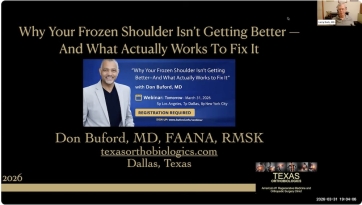
If you want a deeper dive—including treatment algorithms, demonstrations, and real-world application—watch the full lecture below:
👉 Frozen Shoulder Lecture
🧠 Bottom Line
Frozen shoulder is not:
-
Just inflammation
-
Just stiffness
-
Just a shoulder problem
It’s a system-driven condition with a local manifestation.
And when you treat it that way:
-
Outcomes improve
-
Recovery accelerates
-
Patients avoid unnecessary procedures
📍 For Patients Considering Options
Most patients are never told that timing, biology, and stage specific treatment can dramatically change the outcome.
If you’ve been told: “Just wait it out” OR “You’ll eventually need something more invasive”
You may not have been given the full picture.
If your symptoms are not improving, or you've been told to simply "wait it out", a more targeted evaluation may help identify the most effective next step.
We are located in Dallas, Texas.
Our contact number is (877) 777-8883.
Every evaluation at Texas Orthobiologics is done by an orthopedic surgeon using in-office musculoskeletal ultrasound. Getting the diagnosis right is what decides whether an injection is worth doing at all.
Common questions
- How long does frozen shoulder last?
- Most patients are told 12 to 24 months. Dr. Buford's goal is closer to three months from the initial evaluation, and the difference comes from identifying which of the three stages the shoulder is in and treating for that stage rather than waiting. He set out this approach in a 2026 article in the Journal of Orthopaedic Experience & Innovation, drawing on more than 26 years of shoulder practice.
- What is the fastest way to treat frozen shoulder?
- There is no single fastest treatment, and looking for one is why most patients lose a year. The best outcomes come from matching the intervention to the stage: calming inflammation while pain dominates, intervening mechanically once stiffness dominates, and guiding progression through thawing. Systemic drivers are assessed at the same time, because leaving them unaddressed is the most common reason recovery stalls.
- Is physical therapy enough for frozen shoulder?
- Usually not, and mistimed physical therapy makes it worse. Aggressive stretching during the freezing stage, when pain and inflammation dominate, increases guarding and slows recovery. Physical therapy matched to the stage is valuable. Generic protocols applied regardless of stage are the most common reason patients arrive having done months of therapy with no improvement.
- Do steroid injections fix frozen shoulder?
- No. A steroid injection can reduce pain temporarily, but it does not resolve the capsular contracture or the systemic drivers underneath it, and repeated injections may blunt healing. There is a legitimate use for one: making the freezing stage tolerable while the actual plan is put in place. What it is not is the plan
- What is hydrodilation and does it work?
- Hydrodilation uses fluid to expand the contracted shoulder capsule, and it can produce a rapid gain in range of motion. Timing decides whether it works. It is most effective in Stage 2, the frozen stage, when stiffness rather than pain dominates. Performed during the painful freezing stage it is far less useful, which is why establishing the stage comes before choosing the procedure.
- When should surgery be considered?
- Rarely, and only after stage-matched treatment has had a fair trial. Arthroscopic capsular release is reserved for shoulders that do not respond to targeted non-surgical care, hydrodilation, or manipulation under anesthesia. Most frozen shoulders treated at the right stage never reach that point, which is why establishing the stage early matters more than deciding about surgery early.
- Can frozen shoulder come back?
- It can, and recurrence risk stays high whenever the systemic drivers are left unaddressed. Frozen shoulder disproportionately affects women aged 40 to 60 and people with diabetes, which points at metabolic and hormonal contributors rather than a purely local capsular problem. Evaluating fasting insulin and glucose, hormonal status, and inflammatory markers is part of reducing the chance of it returning.
- What about shoulder embolization for frozen shoulder?
- The evidence is thin. The best available is a 2025 systematic review and meta-analysis in the Journal of Vascular and Interventional Radiology covering 12 studies and 329 shoulders, and not one of them was a randomized controlled trial. Every study was single-arm with no control group. Frozen shoulder improves on its own over 12 to 24 months, so uncontrolled results cannot separate the procedure from natural recovery.