
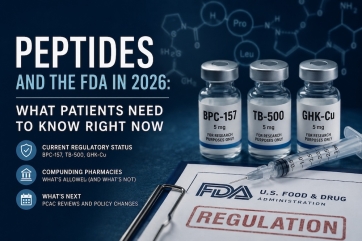
Peptides, Compounding Pharmacies, and the FDA: What Patients Actually Need to Know in 2026
There is a tremendous amount of confusion right now around peptides like BPC-157, TB-500, and GHK-Cu. Patients hear one thing online, another thing from clinics, and something completely different from pharmacies or social media influencers.
Here is the reality:
The regulatory situation is complicated, evolving, and frankly somewhat messy right now.
A lot of people are speaking with absolute certainty when the truth is that the FDA landscape around peptides has been shifting rapidly since 2023, and especially throughout 2025 and 2026.
Let’s break down what is actually happening.
First: What Governs Compounding Pharmacies?
Under Section 503A of the Federal Food, Drug, and Cosmetic Act, compounding pharmacies are only allowed to use certain bulk drug substances.
In simple terms, a substance generally must meet one of these requirements:
- It has an official USP or National Formulary monograph
- It is already part of an FDA-approved drug product
- It appears on the FDA’s official 503A Bulks List
The important point is this:
BPC-157, TB-500, and injectable GHK-Cu are not FDA-approved drugs, and they are not currently on the formal 503A Bulks List.
That is where the controversy starts.
The “Category” System Created Even More Confusion
For years, the FDA used an interim system that placed nominated bulk substances into different categories while they were being reviewed.
Category 1
These substances were under review and the FDA generally exercised “enforcement discretion,” meaning pharmacies were often allowed to compound them while evaluation was ongoing.
Category 2
These substances raised significant FDA safety concerns. The FDA stated these should not be compounded.
Category 3
These substances did not have enough supporting information submitted for review.
In late 2023, several popular peptides — including BPC-157 and TB-500 — were moved into Category 2.
That was a major turning point.
What Is the Current Status of These Peptides?
BPC-157
BPC-157 was placed into Category 2 because the FDA identified safety concerns and a lack of adequate human clinical data.
As of May 2026, BPC-157 is still not formally approved for compounding under 503A.
However, the FDA has scheduled a Pharmacy Compounding Advisory Committee (PCAC) meeting for July 23–24, 2026 to discuss whether BPC-157 should potentially be added to the 503A Bulks List.
That meeting matters — but it is important to understand that the committee is advisory only. It does not automatically change the law.
TB-500
TB-500 is in a very similar position.
It was also categorized as a substance with significant safety concerns and is not currently approved for routine compounding under 503A.
Like BPC-157, TB-500 is scheduled for FDA advisory committee review in July 2026.
GHK-Cu
GHK-Cu has been somewhat different from the beginning.
Historically, topical formulations had a more permissive regulatory position than injectable formulations.
Injectable GHK-Cu has never had clear FDA authorization for routine compounding under 503A.
The FDA is expected to further evaluate GHK-Cu through the PCAC review process in 2027.
What About the RFK Jr. Announcement?
This is where things became even more confusing.
In early 2026, HHS Secretary Robert F. Kennedy Jr. publicly discussed reconsidering restrictions on several peptides that had previously been categorized as safety concerns.
Many people interpreted this as meaning peptides had suddenly become “legal again.”
That is not what happened.
Political statements are not the same thing as formal FDA rulemaking.
Even if the FDA ultimately softens its position on some peptides, that process still requires formal review, recommendations, and regulatory action.
At the moment, the legal and regulatory framework remains unsettled.
So Are Clinics and Pharmacies Still Using These Peptides?
Yes. Many are.
Some clinics and pharmacies believe the enforcement environment is changing.
Others are operating based on anticipated future FDA decisions.
Some are relying on legal interpretations involving research-use positioning or physician discretion.
And some are simply taking regulatory risk.
The reality is that enforcement has not been uniform.
But patients should understand something important:
Just because a peptide is available online or offered by a clinic does not automatically mean it has formal FDA approval or clear regulatory authorization.
Those are two very different things.
My Perspective as a Physician
I think patients deserve honesty here.
There is significant public interest in peptides because many people are looking for alternatives to chronic medications, steroids, opioids, or surgery.
At the same time, we also have to acknowledge that many of these compounds still lack large-scale human clinical trials and long-term safety data.
That does not automatically mean they are dangerous.
But it also does not mean the science is settled.
Right now, the peptide landscape is somewhere between emerging medicine, regulatory uncertainty, and rapidly growing public demand.
That is why patients need physicians who understand both the science and the regulatory realities — not just marketing.
Bottom Line
As of May 2026:
- BPC-157 is not formally approved for routine 503A compounding
- TB-500 is not formally approved for routine 503A compounding
- Injectable GHK-Cu remains in a gray regulatory area
- FDA advisory committee meetings are scheduled that could significantly influence future policy
- Political announcements do not equal FDA approval
- Many clinics and pharmacies are still operating in a legally uncertain environment
This situation may continue to evolve quickly over the next 12–18 months.
Patients should be cautious about anyone claiming these peptides are either completely “illegal” or completely “approved.”
The truth right now is more complicated than either extreme.
Serving Patients Across Dallas–Fort Worth
Texas Orthobiologics provides regenerative medicine and orthopedic care for patients throughout the Dallas–Fort Worth metroplex, including Dallas, Highland Park, University Park, Plano, Frisco, McKinney, Allen, Southlake, Grapevine, Colleyville, Flower Mound, Irving, Las Colinas, Coppell, Richardson, Garland, Rockwall, Prosper, Celina, Denton, Arlington, Fort Worth, Keller, and surrounding North Texas communities.
References
- FDA. Bulk Drug Substances Used in Compounding Under Section 503A of the FD&C Act
https://www.fda.gov/drugs/human-drug-compounding/bulk-drug-substances-used-compounding-under-section-503a-fdc-act - FDA. Certain Bulk Drug Substances for Use in Compounding May Present Significant Safety Risks
https://www.fda.gov/drugs/human-drug-compounding/certain-bulk-drug-substances-use-compounding-may-present-significant-safety-risks - FDA. Interim Policy on Compounding Using Bulk Drug Substances Under Section 503A of the FD&C Act(Guidance Document PDF)
https://www.fda.gov/media/174456/download - FDA. Pharmacy Compounding Advisory Committee Meeting Information
https://www.fda.gov/advisory-committees/pharmacy-compounding-advisory-committee - Alliance for Pharmacy Compounding. FDA Puts Some Peptides Off-Limits
https://a4pc.org/news/2023-10/fda-puts-some-peptides-off-limits - Regulatory Affairs Professionals Society (RAPS). FDA Considers Adding Peptides to Bulk Drug Compounding List
https://www.raps.org/news-and-articles/news-articles/2024/4/fda-considers-adding-peptides-to-bulk-drug-c - National Community Pharmacists Association (NCPA). FDA Releases Guidance for Compounding Pharmacies
https://ncpa.org/newsroom/qam/2025/01/13/fda-releases-guidance-compounding-pharmacies - FDA. Drug Quality and Security Act (DQSA)
https://www.fda.gov/drugs/human-drug-compounding/drug-quality-and-security-act-dqsa



Comments