
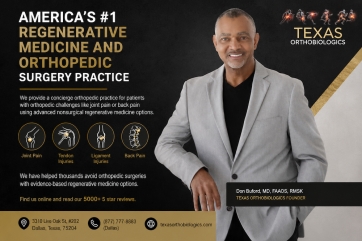
Orthopedic Regenerative Medicine: A Nonsurgical Approach to Joint, Tendon, Ligament, and Spine Pain
By Don Buford, MD, FAAOS, RMSK
Founder, Texas Orthobiologics
For many patients, the traditional treatment pathway for orthopedic pain has remained largely unchanged for decades: medications, injections, physical therapy, and eventually surgery when symptoms become severe enough. While surgery remains an excellent option for many conditions, advances in regenerative medicine have created new opportunities for carefully selected patients seeking nonsurgical solutions.
At Texas Orthobiologics, our focus is helping patients understand all available treatment options so they can make informed decisions about their orthopedic health.
What Is Orthopedic Regenerative Medicine?
Orthopedic regenerative medicine uses the body’s natural healing mechanisms to help support recovery from injuries and degenerative conditions affecting:
- Joints
- Tendons
- Ligaments
- Muscles
- Certain spine conditions
Rather than simply masking symptoms, regenerative medicine seeks to create an environment that supports the body’s healing response.
Common regenerative medicine treatments may include:
- Platelet-Rich Plasma (PRP)
- Bone Marrow Aspirate Concentrate (BMAC)
- Image-Guided Orthobiologic Procedures
These treatments are performed using advanced ultrasound guidance to improve precision and accuracy.
Why Consider Regenerative Medicine?
Many traditional treatments focus primarily on reducing pain and inflammation. While these approaches can be effective, they do not always address the underlying tissue dysfunction.
Potential benefits of regenerative medicine may include:
- Reduced pain
- Improved function
- Enhanced activity levels
- Support for the body’s natural healing response
- Delaying or avoiding surgery in selected patients
For active individuals, regenerative medicine can offer an opportunity to remain engaged in the activities they enjoy while pursuing a less invasive treatment pathway.
Conditions Commonly Treated
Patients often seek regenerative medicine consultation for:
Joint Arthritis
- Knee arthritis
- Hip arthritis
- Shoulder arthritis
- Ankle arthritis
Tendon Injuries
- Rotator cuff tendinopathy
- Tennis elbow
- Golfer’s elbow
- Patellar tendon injuries
- Achilles tendon disorders
Ligament Injuries
- Partial ligament tears
- Chronic ligament instability
- Sports-related injuries
Spine Conditions
- Certain forms of disc-related pain
- Facet joint conditions
- Chronic mechanical back pain
Not every condition is a candidate for regenerative medicine, which is why a comprehensive evaluation is critical.
Who May Be a Good Candidate?
The best candidates often include patients who:
- Have mild to moderate arthritis
- Have tendon or ligament injuries
- Want to avoid or delay surgery
- Have not achieved satisfactory results from conservative care
- Desire a comprehensive evaluation of all treatment options
Patients with advanced “bone-on-bone” arthritis may still have regenerative options available, although expectations and treatment goals must be discussed carefully.
The Importance of Proper Diagnosis
One of the most overlooked aspects of successful orthopedic care is obtaining an accurate diagnosis.
At Texas Orthobiologics, treatment recommendations are based on:
- Comprehensive medical history
- Physical examination
- Diagnostic ultrasound
- MRI review when appropriate
- Functional assessment
- Evidence-based treatment principles
The goal is to understand not only where the pain is located, but why it exists.
How Long Do Results Last?
Results vary depending on:
- The condition being treated
- Severity of tissue damage
- Patient age
- Activity level
- Overall health
- Treatment selected
Many patients notice improvement within weeks, while others continue improving for several months following treatment.
When successful, regenerative medicine may provide long-lasting benefits by supporting tissue recovery rather than simply suppressing symptoms.
Surgery and Regenerative Medicine Are Not Opposites
A common misconception is that regenerative medicine and orthopedic surgery compete with one another.
In reality, they often complement each other.
As a board-certified orthopedic surgeon with advanced training in regenerative medicine and musculoskeletal ultrasound, I believe patients deserve an unbiased evaluation of every appropriate treatment option—from physical therapy and regenerative procedures to minimally invasive surgery and advanced reconstructive techniques when necessary.
The right treatment is the one that best fits the individual patient.
Experience Matters
Regenerative medicine is a rapidly evolving field. Success depends heavily on:
- Proper patient selection
- Accurate diagnosis
- Appropriate treatment planning
- Advanced image-guided injection techniques
- Evidence-based decision making
Our practice has helped thousands of patients explore nonsurgical orthopedic solutions and make informed decisions regarding their care.
Schedule a Consultation
If you are struggling with joint pain, tendon injuries, ligament injuries, or chronic back pain and want to learn whether regenerative medicine may be appropriate for your condition, we invite you to schedule a consultation.
Texas Orthobiologics
3310 Live Oak Street, Suite 202
Dallas, Texas 75204
Phone: (877) 777-8883



Comments